
Ten minutes is the exact dose most older adults can repeat every single day. That’s the whole idea behind this 28 day chair yoga challenge: one short, mostly seated session a day, for four weeks, with a printable chart that lives on your fridge door.
The full schedule, all ten moves, and the weekly progression are right here on the page. Print the chart, tape it next to your favorite armchair, and check off a box each morning. By day 28 you’ll own a daily habit, stronger legs and core, and honest answers to the weight question everyone brings to these challenges.
Table of Contents
Will a chair yoga challenge help you lose weight?
Short answer: indirectly, and the math matters here.
Seated yoga burns light calories. An hour sits somewhere around 120 to 200 calories, depending on your body size and how hard you push (Harvard Health maintains the most quoted calorie table for common activities). A ten-minute session covers roughly 25 of them. A banana has more.
So the scale rarely notices chair workouts on their own. Two-and-a-half things do the real work over 28 days:
Muscle. Strength work protects muscle while your body loses fat. Muscle is what shapes the body people chase when they chase a smaller number. The CDC’s guidance for adults 65 and older includes strength work on at least two days a week, on top of 150 minutes of weekly activity. Ten minutes a day for 28 days stacks up 280 activity minutes, and the standing poses and core moves in this challenge count toward those strength sessions.
Stress. Cortisol, the stress hormone, encourages fat storage around the midsection and turns up appetite, especially for the salty-sweet stuff (Harvard Health explains the stress-overeating loop). Slow breathing and gentle movement bring it down. Your daily session doubles as stress management, which quietly supports the scale over weeks. For the midsection specifics, see our guide to chair yoga for belly fat.
Habit. This is the part worth the most. Four weeks of one small, repeatable action builds the loop that keeps you moving in month two and month three. Habit researchers at UCL put the average build time for a single habit around 66 days and published the numbers; four weeks needs a smaller promise, close enough to reach before motivation runs out. Weight loss plans rarely fail because someone picked the wrong exercise. They fail on day 12, when the plan got inconvenient and life took over.
One thing to park right now: belly fat doesn’t melt in order of where you poked it. No chair pose spot-reduces your abdomen. The core work strengthens what’s underneath, stress management takes the edge off visceral fat storage, and the bigger calorie equation runs through food and total movement. If you want the food side handled too, eat slowly at one meal a day. That’s it. I cover it as the week 3 focus below.
Before day 1: setup, chair, and safety
| Item | What works |
|---|---|
| Chair | Armless, sturdy, seat at knee height, no wheels. Park it against a wall for week 1. |
| Feet | Flat on the floor in every seated move. If they dangle, put a book or step under them. |
| Optional extras | Yoga mat for the standing variations, a light resistance band for week 3, a glass of water, a pen for the chart. |
| Clothing | Loose layers. Seniors chill faster during low-intensity movement than you’d expect. |
Two safety notes, then we start. Check with your doctor first if you have unmanaged blood pressure, a recent surgery, severe osteoporosis, or any pain that spikes when you move. The NIH’s exercise guide for older adults covers the same advice in more depth and is worth a five-minute read. And skip everything that hurts. A stretch feels like lengthening; pain feels like a mistake. At 70 plus, that distinction is basically the whole safety manual.
The ten moves in the challenge
Free chair yoga exercises for seniors share a few traits: they’re gentle on the joints, they need zero equipment, and they can scale up or down depending on your standing ability. Here’s the full set, written so a printable chart can carry them.
1. Seated mountain pose — Sit tall near the front of the seat. Feet flat, hands on thighs, spine long, shoulders down away from the ears. Breathe slowly through the nose. Every other move in the challenge starts from this shape.
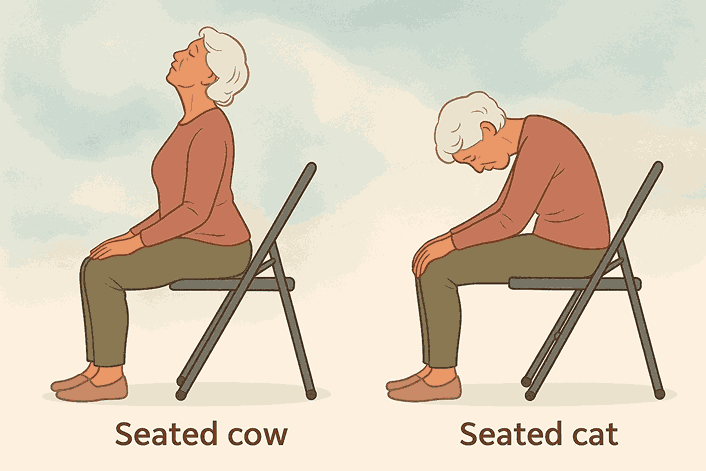
2. Seated cat-cow — Hands on your knees. Inhale and open the chest forward (cow). Exhale and round the back, chin dropping toward the chest (cat). Flow at roughly one shape per breath, 8 rounds. This wakes up every disc and muscle along the spine.
3. Seated marching — Sit tall and lift one knee up a few inches, then lower. Alternate legs like a slow parade. Sixty seconds, arms pump if you can. Pull this one out whenever you want to raise your heart rate without leaving the chair.
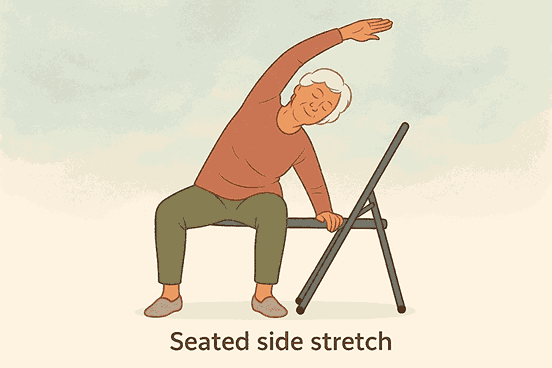
4. Seated oblique dips — Hands behind your head, elbows wide. Lengthen the spine, then lean toward the right side, keeping the chest facing forward. Hold for 3 breaths, come back up, repeat on the left. 8 times per side.
5. Chair warrior I — Hold the back of the chair. Step one foot ahead of you and one foot behind, both heels down, back leg straight. Bend the front knee over the ankle. Reach the hand on your back-leg side up toward the ceiling. Hold 3 to 5 slow breaths. Strong thighs are the currency of independence, and this pose is where you buy them. If standing doesn’t suit your body that day, march your back knee straight up while you sit, and reach your arms overhead. Same muscles, gentler angle. Shoulder trouble? Our frozen shoulder routine covers gentler overhead work.
6. Chair warrior II — Holding the chair’s back with the right hand, step the right foot forward and the left foot back, outer edge of the back foot parallel to the chair. Bend the front knee. Left arm reaches back, gaze follows. Level the shoulders. Hold 3 to 5 breaths, switch sides. Practical note: this pose trains the exact hips and thighs that manage getting into a low car seat.
7. Seated good mornings — Sit tall, hands behind the head, elbows wide. Exhale and bring your chest down toward your thighs with a long, flat back, as if the top of your head were reaching forward. Inhale and rise. 10 reps. Your glutes and the muscles along the spine do the work, which is exactly why it earns its gym nickname.
8. Seated oblique twists — Sit tall, hands behind your head (or one hand on the chair’s backrest for support). Exhale and rotate your chest toward the right, keeping the hips planted. Hold 3 breaths. Return to center, then twist left. 10 rounds total. The gentlest version rests a hand lightly on the chair back and lets it travel with you.
9. Seated bicycle crunches — Sit tall with knees wide. Exhale and lift your left knee while bringing your right elbow to meet it. Inhale back to center. Alternate sides, 8 reps per side. Move the lower body less and the ribs more if your hips complain.
10. Chair boat pose — Grip the sides of the seat. Exhale and curl your chin to your chest as you lift one knee toward it. Hold 3 breaths. Repeat on the other side, then, if the lower back stays quiet, try both knees at once. Come out immediately if you feel strain in the lower back. Core strength arrives on schedule; impressive poses arrive whenever they feel like it.
A 10 minute chair yoga routine for day 1
Run this flow, timed loosely, and you’ve completed your first day:
- Seated mountain, 1 minute (just breathe and settle)
- Seated cat-cow, 2 minutes
- Seated marching, 1 minute
- Arm circles, 30 seconds each direction (shoulder rolls count if shoulders feel crunchy)
- Seated oblique dips, 2 minutes
- Seated twists, 1 minute
- Seated good mornings, 1 minute
- Marching again, 30 seconds
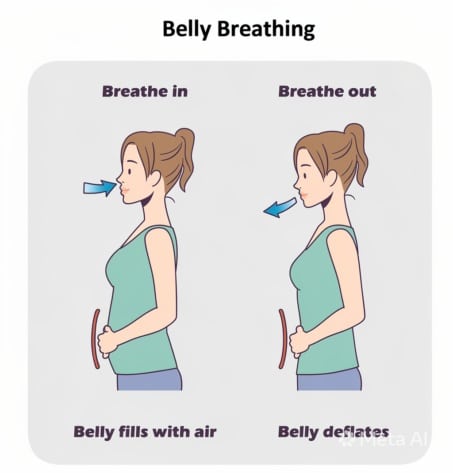
- Mountain pose and slow breathing, 1 minute (if breathing is hard, borrow these seated breathing exercises, which pair perfectly with the rest days too)
That’s the day 1 anatomy. The chart below grows it one move at a time so week 1 never asks more than your first morning did.
Your free printable chair yoga chart (the full schedule)
Print this table or copy it into your notes app. Minutes are approximate; the moves are listed by their number above. Circle each day when it’s done. Prefer single poses on a sheet instead of a full plan? Our separate chair yoga chart covers that job, and this exact schedule ships as a one-page printable PDF next to the article.
| Day | Minutes | Your routine |
|---|---|---|
| 1 | 10 | Starter flow (moves 1-9 above) |
| 2 | 10 | Starter flow + seated calf raises ×12 |
| 3 | 10 | Starter flow + chair warrior I (3 breaths a side) |
| 4 | 10 | Starter flow + good mornings ×12 |
| 5 | 10 | Starter flow + chair warrior II (3 breaths a side) |
| 6 | 10 | Starter flow + extra 1 min marching; note how week 1 felt |
| 7 | 5 | Rest day: neck rolls, slow breathing, gentle everything |
| 8 | 10 | Full flow continuous: every week 1 move in order |
| 9 | 10 | Full flow + bicycle crunches ×8 a side |
| 10 | 10 | Full flow + standing sun salutation with the chair (or seated version) |
| 11 | 10 | Full flow + boat pose (one knee, then both if comfortable) |
| 12 | 11 | Full flow + 1 extra minute of marching |
| 13 | 10 | Full flow + resistance band arm press (light band, 2 × 10) |
| 14 | 5 | Rest day + mindful eating at one meal (see week 3 note) |
| 15 | 12 | Circuit A ×2: mountain, marching 1 min, warrior I, dips, twists |
| 16 | 12 | Circuit B ×2: cat-cow, good mornings, warrior II, bicycle crunches |
| 17 | 12 | Circuit A ×2 + boat pose finisher |
| 18 | 12 | Circuit B ×2 + 1 min shoulder rolls |
| 19 | 12 | Circuit A ×2 + warrior holds 5 breaths a side |
| 20 | 12 | Circuit B ×2 + 1 min slow marching cooldown |
| 21 | 5 | Rest day + log one sentence: “Three weeks in, I noticed…” |
| 22 | 12 | Circuit A ×3, 5-breath holds |
| 23 | 12 | Circuit B ×3 |
| 24 | 12 | Circuit A ×3 + boat pose finisher |
| 25 | 12 | Circuit B ×3 + extra 1 min marching |
| 26 | 12 | Day 1 full test flow, straight through |
| 27 | 12 | Free choice day: your three favorite moves, 2 rounds each |
| 28 | 5 | Victory lap: mountain pose, breathing, then take your day 1 measurements again |
Week by week, the challenge asks this of you:
- Week 1, build the habit. Ten easy minutes, same flow, one new move added each day. The only goal is showing up.
- Week 2, add strength and range. Warrior poses, crunches, and boat pose join the party. Sessions stretch by a minute.
- Week 3, circuits. Two rounds of pairings, a light band for awareness, and a mindful eating check-in.
- Week 4, volume and proof. Three rounds, longer holds, and measurable tests to compare against day 1.
The day 1 measurements worth taking
Before the chart starts, grab a pen and record three things: how long you can stand from a chair 5 times without using your arms, how far you can reach toward your toes seated, and today’s waist measure at belly-button height. They make day 28 feel arrived rather than assumed.
What happens on day 29
Three lanes:
- Repeat the chart with every hold two breaths longer. It stays fresh at zero planning cost.
- Graduate to 15 minutes a day with our longer daily chair yoga routine for seniors, and swap in standing versions of the same moves when your balance feels reliable.
- Add walking before or after each session. Day 28 plus a ten-minute walk is a routine most people keep for years, because it still fits in a lunch break.
Frequently asked questions
Does chair yoga help you lose weight? It supports weight loss more through muscle, stress relief, and daily habit than through direct calorie burn. Seated sessions burn light calories, so pair the practice with slower eating and a bit more daily walking to see the scale move.
How many calories does 10 minutes of chair yoga burn? Roughly 20 to 35, depending on your body size and effort level. An hour of seated practice sits around 120 to 200. The practice earns its keep through strength work and consistency instead of the calorie math.
Is a 28 day chair yoga challenge good for beginners over 70? Yes, and this one is built for it: every move sits in a chair, each week adds a single new move, and there are rest days every seven days. Talk to your doctor first if you have severe osteoporosis, recent surgery, or unmanaged blood pressure.
Can I do the challenge if I can’t stand at all? Absolutely. Only days 3, 5, 10, and 19 include standing variations, and each one names its seated swap. You can complete all 28 days without ever leaving the chair.
What kind of chair works best? An armless, sturdy chair without wheels, seat at knee height, parked against a wall while you’re starting. Office task chairs roll and recline; dining chairs usually nail it.
Do I need a yoga mat or any equipment? No for weeks 1 and 2. Week 3 adds an optional light resistance band, and the standing poses feel better on a mat or carpet. Water and a pen for the chart cover the rest.
What should I do after the 28 days? Repeat the chart with longer holds, extend to 15 minutes, or add a short daily walk. Bookmark the measurements from day 1 so your day 56 comparison is just as satisfying as day 28.
Final thought
A scale change requires four more weeks of kitchen attention than any yoga chart can offer. What the chart can hand you in 28 days is real: stronger legs, a calmer nervous system, a core that carries you up stairs, and a morning ritual that survived the trip to the fridge. Print the chart. Fill in the first box tomorrow. The other 27 will take care of themselves, usually with you noticing on week 3 that you’ve stopped negotiating with the alarm.