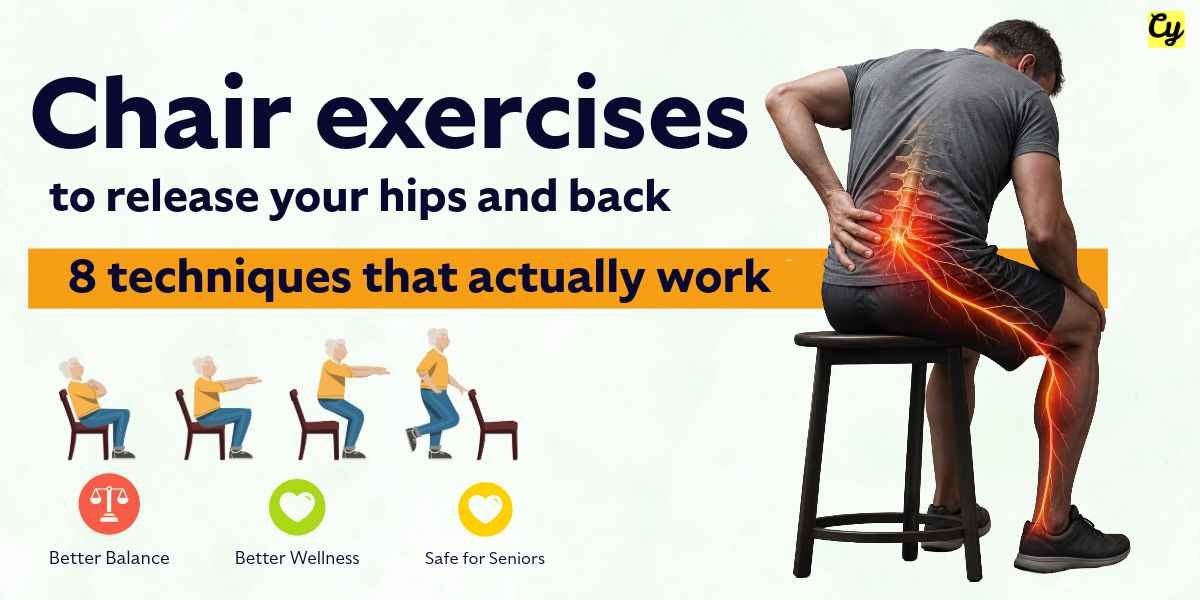
You sit down.
Your feet are on the floor. Your hands rest on your thighs. Then you start moving, slowly, one breath at a time.
That’s the basic idea behind tai chi in a chair.
Tai Chi usually involves slow, gentle movements, controlled breathing, and focused attention. And according to the National Center for Complementary and Integrative Health, Tai Chi can be adapted for sitting, standing, or walking.
So if standing exercises don’t feel comfortable, a chair gives you another way to practice.
You need a sturdy chair.
That’s about it.
What is tai chi in a chair?
Tai chi in a chair is a seated way to practice gentle Tai Chi movements.
Traditional Tai Chi is usually practiced while standing and involves slow movements, weight shifting, breathing, and body awareness. With a chair routine, you stay seated while moving your arms, shoulders, upper body, and legs.
The pace stays slow.
Your breathing stays comfortable.
And you control how far you move.
If you want to learn more about Tai Chi itself, read our guide to Tai Chi for seniors.
Is seated tai chi good for seniors?
It can be a practical way to add gentle movement to your day.
Research on Tai Chi in older adults has found that it can help with balance and may reduce falls. NCCIH reports that research reviews have found Tai Chi may reduce the rate of falls and the number of older adults who experience falls.
The National Institute on Aging also lists Tai Chi as a balance exercise for older adults. Its safety advice includes moving slowly and keeping a sturdy chair, person, or wall nearby when support is needed.
There’s an important detail here, though.
Much of the research involves traditional, standing Tai Chi. Chair Tai Chi keeps you seated, so you shouldn’t assume that every benefit found in standing Tai Chi has been proven for every seated movement.
If you have a medical condition, recent injury, severe dizziness, or significant balance problems, talk with your healthcare professional before starting a new exercise routine.
What kind of chair should you use?
Pick a chair that stays firmly on the floor.
A sturdy dining chair usually works well.
Avoid chairs with wheels. Very soft sofas can also make movement harder because you sink into the cushion.
Before you begin, check:
- Your feet can reach the floor.
- The chair doesn’t rock.
- The legs sit firmly on the floor.
- You have enough space to move your arms.
- Nothing is blocking your feet.
Your chair matters.
A shaky chair can make a seated exercise routine much less comfortable.
For more chair-based movements, see our guide to chair exercises for seniors.
7 tai chi movements you can do in a chair
Start slowly.
Try each movement for about 30 seconds to 1 minute. You can gradually increase the time if the movement feels comfortable.
1. Seated Tai Chi breathing
- Sit comfortably with both feet flat on the floor.
- Place your hands over your lower abdomen.
- Take a slow breath in through your nose.
- Let your belly move gently as you breathe in. Then breathe out slowly.
- Repeat for 5 to 10 breaths.
- Don’t force your breathing.
- The goal is to settle your body before you start moving.

2. Seated cloud hands
- Sit tall.
- Raise your hands comfortably in front of your body.
- Move one hand slowly across your body while the other hand moves in the opposite direction.
- Then reverse the movement.
- Keep your shoulders relaxed.
- The movement doesn’t need to look perfect. Small, smooth movements are fine.
Try 5 repetitions in each direction.
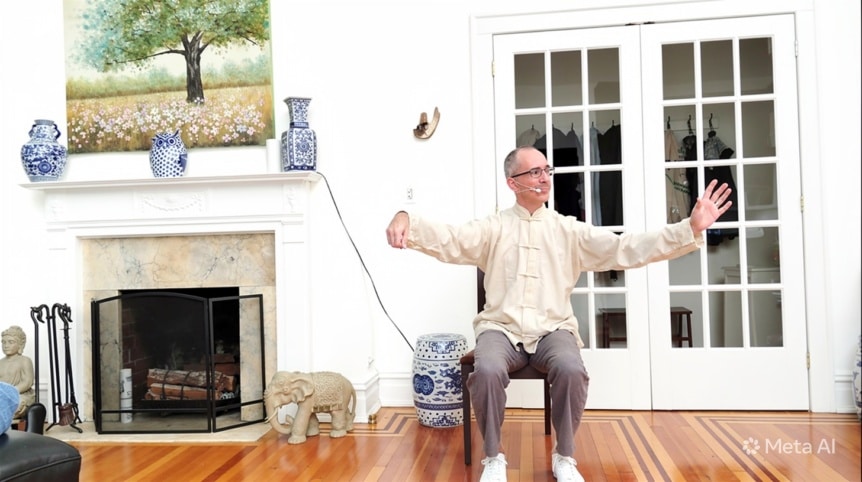
3. Seated arm circles
- Hold your arms comfortably in front of you.
- Make small circles with your hands and arms.
- After several circles, change direction.
- Keep the circles small at first.
- If your shoulders feel uncomfortable, lower your arms and make the movement smaller.
- Try 5 circles in each direction.
You can also add some of the movements from our daily chair yoga routine for seniors on days when you want a different seated workout.
4. Seated weight shifts
- Place both feet flat on the floor.
- Slowly shift your upper body a little toward the right.
- Return to the centre.,mn
- Then shift gently toward the left.
- Keep the movement small.
- Try 5 to 8 repetitions on each side.
Weight shifting is an important part of traditional Tai Chi practice. If you’re able to exercise safely while standing, you can learn more with our guide to Tai Chi walking for seniors.
5. Seated opening movement
- Start with your hands near your thighs.
- Slowly raise both hands toward chest height.
- Then lower them gently.
- Keep your elbows relaxed.
- Repeat 5 to 10 times.
- Think about making the entire movement smooth.
- There’s no need to rush.
6. Seated heel and toe raises
- Keep both feet flat.
- Lift your heels while keeping your toes on the floor.
- Lower your heels.
- Then lift your toes while keeping your heels down.
- Repeat 8 to 10 times.
These movements also appear in our chair exercises for seniors guide.
They’re simple, but your lower legs and ankles still have to do some work.
7. Seated Tai Chi reach
- Sit tall with your hands resting on your thighs.
- Slowly reach one arm forward and slightly upward.
- Bring it back.
- Then repeat with the other arm.
- Keep the movement within a comfortable range.
- You don’t have to reach as far as possible.
- Try 5 repetitions on each side.
A simple 10-minute tai chi in a chair routine
You don’t need a long workout.
Try this:
Minute 1: Seated breathing
Minutes 2-3: Seated cloud hands
Minutes 4-5: Arm circles and opening movements
Minutes 6-7: Seated weight shifts
Minutes 8-9: Heel and toe raises
Minute 10: Slow breathing
If 10 minutes feels like too much, start with 5 minutes.
Then build from there.
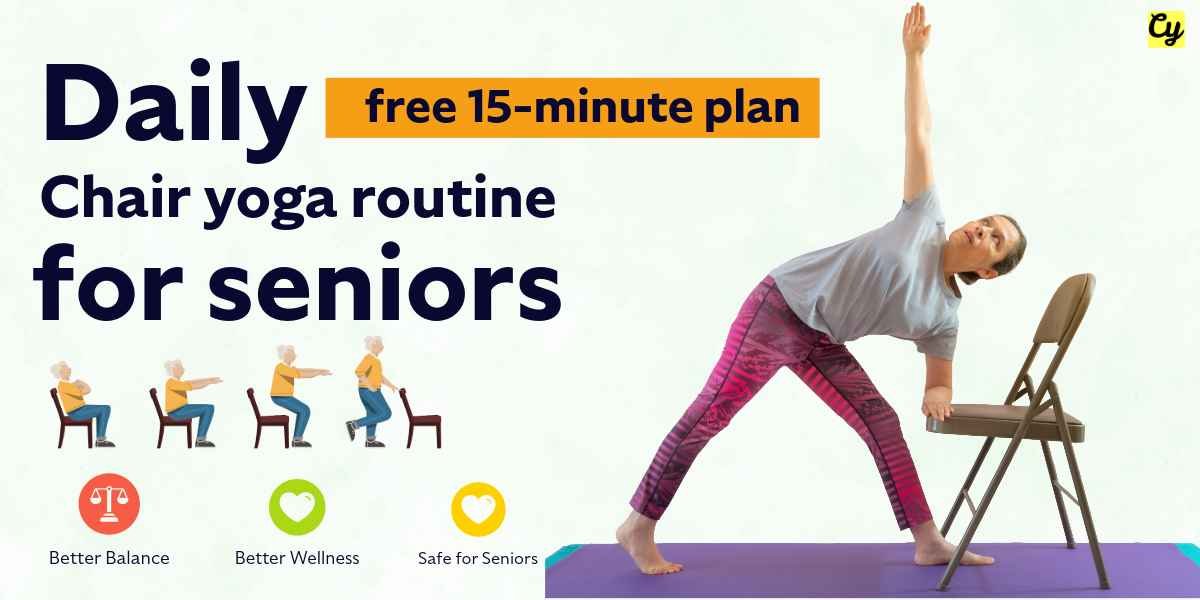
You can also alternate this routine with our 15-minute daily chair yoga routine for seniors.
How often should you practice?
Start with a routine you can actually stick to.
Try 5 to 10 minutes a day.
You could practice after breakfast, during an afternoon break, or after you’ve been sitting for a long time.
Some days you’ll feel like doing 10 minutes.
Other days, 5 minutes might be enough.
That’s okay.
The goal is to keep moving regularly.
5 tips for practicing Tai Chi in a chair
1. Keep your feet grounded.
Place both feet comfortably on the floor.
This gives you a stable base while your upper body moves.
2. Relax your shoulders.
Check your shoulders every few movements.
If they’re creeping toward your ears, let them drop.
3. Keep movements small.
You don’t need huge movements.
Start with a comfortable range and gradually increase it if the movement feels good.
4. Keep breathing.
Don’t hold your breath while concentrating.
Breathe normally and keep the movement slow.
5. Stop if something hurts.
Mild muscle effort can happen during exercise.
Sharp or worsening pain is different.
Stop if something hurts.
If you’re unsure whether a movement is appropriate for you, ask your doctor or physical therapist. NIA gives similar safety advice for older adults doing balance exercises.
Can you do tai chi in a chair every day?
A short seated routine can fit easily into a daily schedule.
You might practice in the morning or after spending several hours sitting.
Some days you might do 10 minutes.
Other days, 5 minutes of breathing and gentle movements may be enough.
Keep the movements comfortable.
And pay attention to how your body responds.
Who might prefer seated tai chi?
Tai Chi in a chair may appeal to people who:
- Prefer seated exercise
- Want a gentle movement routine
- Are new to Tai Chi
- Don’t want floor exercises
- Prefer exercising at home
- Want to move at a slower pace
It can also be a useful starting point for someone who feels more comfortable exercising while seated.
If you’re unable to stand safely, though, don’t use chair Tai Chi as a substitute for an individualized exercise program from a physical therapist or other qualified professional.
Tai Chi in a chair vs. regular Tai Chi
The biggest difference is simple: you stay seated.
Regular Tai Chi usually involves standing, shifting weight between the legs, and moving through different positions.
Chair Tai Chi removes much of the standing component.
That can make the movements easier to approach, but it also means you’re not practicing every part of a traditional standing Tai Chi session.
If your main goal is improving standing balance or walking, ask your healthcare professional which type of exercise fits your needs.
What does the research say about Tai Chi?
The research on Tai Chi and older adults is encouraging, particularly around balance and falls.
NCCIH says Tai Chi may improve balance and stability in older people and may reduce the risk of falls. One review it cites found a 19% reduction in fall rate and a 20% reduction in the number of people who experienced falls, although the certainty of evidence differed between those outcomes.
NIA also includes Tai Chi among balance exercises for older adults and notes that balance activities can help prevent falls and fall-related injuries.
There’s also newer research on Tai Chi and cognitive function. An NIA-funded study involving adults age 65 and older with mild cognitive impairment found improvements in cognitive test scores among both traditional and cognitively enhanced Tai Chi groups compared with stretching.
But these studies shouldn’t be used to promise that seated Tai Chi will produce the same results.
Chair Tai Chi is a modified form of the practice.
For a detailed overview of the current evidence, see the NCCIH Tai Chi guide.
A chair and 10 minutes can get you started
Find a sturdy chair.
Put both feet on the floor.
Take a slow breath.
Then start moving.
Tai Chi in a chair gives you a simple way to practice slow, controlled movement while staying seated.
Start with 5 minutes.
If that feels good, try 10.
And when you want more seated movement, explore our chair exercises for seniors and daily chair yoga routine for seniors.