Your keys are in the fridge. You walked into the kitchen for something and stood there for 45 seconds. A name you’ve known for 30 years just won’t come. Memory exercises for seniors are one of the most searched topics in senior health — and one of the most misunderstood.
Sound familiar?
Memory slippage after 60 is common. But a lot of it is preventable, and some of it is reversible. The research on this has gotten genuinely interesting in the last decade.
This guide covers the memory exercises that actually work for seniors, including a 12-minute meditation called Kirtan Kriya that’s been studied specifically for Alzheimer’s prevention. Everything here can be done seated, at home, with no equipment.
Table of Contents
Why memory changes as we age
The brain shrinks slightly with age. The hippocampus — the region that handles memory formation — loses about 1–2% of its volume per year after 60, according to research published in Frontiers in Behavioral Neuroscience.
But here’s what matters: that decline is not fixed. Exercise, meditation, sleep, and mental stimulation all directly affect how fast (or slow) your brain ages.
The NIH calls this building “cognitive reserve.” The more you build, the longer you stay sharp.

Physical exercise first (yes, really)
Before we get to brain games and meditation, physical movement deserves the top spot.
A 2025 meta-analysis published in PMC reviewed studies on older adults from 1970 to 2025 and found that moderate-intensity aerobic exercise directly increases hippocampal size and improves memory scores. Chair yoga counts. So does walking. So does anything that gets your heart rate up for 20+ minutes.
If you’re doing our 28-day chair yoga challenge, you’re already working on your memory. That’s not a metaphor — it’s the actual mechanism.
Kirtan Kriya: the 12-minute memory meditation
This is the one worth knowing about.
Kirtan Kriya is a Kundalini meditation that combines chanting, finger movements (called mudras), and focused breathing. It takes 12 minutes. You do it seated.
Kirtan Kriya is the most researched of all memory exercises for
seniors. Here’s exactly how to do it.
The Alzheimer’s Research and Prevention Foundation has funded multiple studies on it. The findings are consistent: people aged 55 and older who practiced Kirtan Kriya for 12 minutes a day over 12 weeks showed improved memory, better mood, and reduced stress, with measurable changes in brain connectivity.
A 2016 study in the Journal of Alzheimer’s Disease found yoga meditation was as effective as memory enhancement training in improving brain connectivity related to verbal memory.
How to do Kirtan Kriya:
- Sit comfortably in your chair, spine upright, eyes closed.
- Chant the sounds Saa, Taa, Naa, Maa — either out loud, in a whisper, or silently. Cycle through all 4 repeatedly.
- With each sound, touch a different fingertip to your thumb: Saa (index finger), Taa (middle), Naa (ring), Maa (pinky). Then repeat.
- Continue for 12 minutes. That’s it.
The sounds come from the mantra “Sat Nam,” meaning “my true essence” in Sanskrit. You don’t need to believe in anything for it to work. The finger movements alone activate multiple brain regions simultaneously.
Do it every morning. Same time if you can. The 12-week studies show cumulative benefits, it compounds.

Memory exercises for seniors: 6 that work
These are the memory exercises for seniors that have actual research behind them.
1. Spaced repetition
Pick 5 things you want to remember: names, words in another language, appointments. Review them after 1 day, then 3 days, then a week, then a month.
This is how your brain consolidates information into long-term storage. Apps like Anki do this automatically, but a handwritten index card system works just as well.
2. Dual-task exercises
Walk and talk at the same time, deliberately. Or do chair yoga poses while counting backwards from 100 by 7s.
Combining physical movement with mental tasks trains the brain to handle complexity. It directly targets the kind of memory slippage that shows up in everyday tasks. Dual-tasking is one of the most underrated memory exercises for seniors because it mimics real life.
3. The name-face exercise
When you meet someone, say their name out loud immediately (“Nice to meet you, Margaret”). Then find 1 visual detail about them and connect it to their name. Margaret has silver hair, “Margaret, silver.”
Sounds simple. Works remarkably well. Most people skip the “say it out loud” step and then wonder why they can’t remember names.
4. Story chaining
Pick 10 random objects in your house. Build a story that links them in order. The weirder the story, the better your recall will be.
Bizarre imagery is more memorable than logical sequences. Your brain is not a filing cabinet.
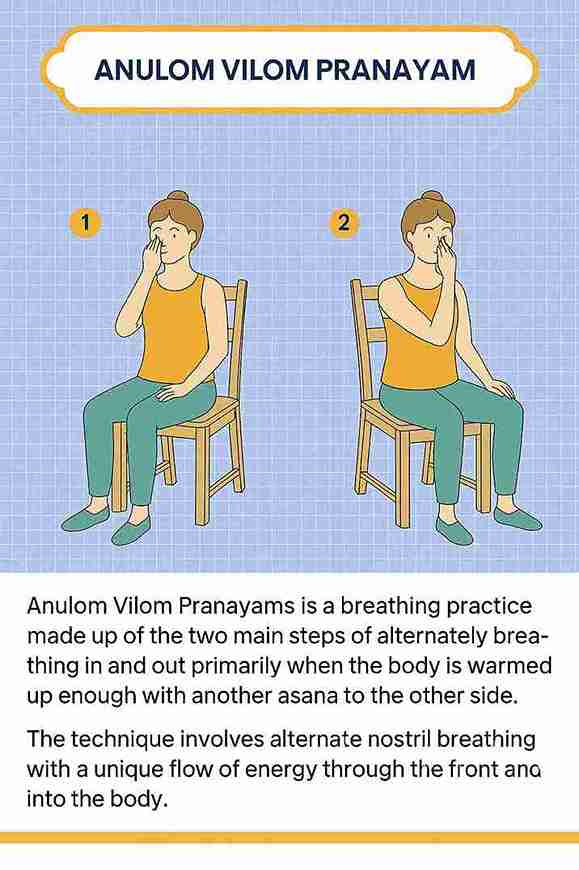
5. Alternate nostril breathing (Nadi Shodhana)
This pranayama exercise from yoga balances activity between the left and right hemispheres of the brain. Close your right nostril with your thumb, inhale through the left. Close left with ring finger, exhale through right. Repeat for 5 minutes.
A 2014 study in Frontiers in Behavioral Neuroscience found meditation practices like this showed positive effects on attention, memory, verbal fluency, and cognitive flexibility in older adults.
You can combine this with your Kirtan Kriya session or do it on its own. Our seated breathing exercises guide has the full sequence.
6. Learn something genuinely hard
A new language. A musical instrument. Chess. Watercolour painting.
The key word is hard. Brain games marketed as “memory training” mostly improve performance on those specific games, not real-world memory. Learning a skill that feels uncomfortable is what builds actual cognitive reserve.
Pick one hard thing and do 20 minutes of it 4 times a week.
Memory exercises for dementia vs. normal aging
One clarification worth making: the exercises above are for normal age-related memory changes, the kind where you forget where you put your glasses.
Dementia is different. Dementia involves progressive cell death and follows a different trajectory.
The research on Kirtan Kriya specifically studied people with “subjective cognitive “decline” people who felt their memory was slipping but hadn’t been diagnosed with dementia. The results were positive. For diagnosed dementia, these exercises may help quality of life but won’t reverse the condition.
If you’re worried about the difference between normal forgetting and something more serious, talk to your GP. The Alzheimer’s Society has a clear checklist on when to be concerned.
How to build a daily routine
Here’s a realistic 20-minute morning routine that covers multiple memory mechanisms:
- Minutes 1–5: Alternate nostril breathing (Nadi Shodhana)
- Minutes 6–17: Kirtan Kriya (the full 12 minutes)
- Minutes 18–20: Review your spaced repetition cards from yesterday
That’s it. 20 minutes. Do it before you check your phone.
Pair it with our daily chair yoga routine in the morning and you’re covering physical memory benefits too.

What doesn’t work
A few things worth cutting from your routine if they’re taking up time without payoff:
Crossword puzzles alone. Fun, but the research shows they mostly improve your ability to do crosswords. Unless you’re also doing aerobic exercise and sleep hygiene, a daily crossword won’t move the needle on memory.
“Brain training” apps. Same issue. Lumosity and similar apps improve game scores, not real-world cognitive performance. A 2014 Stanford letter signed by 75 neuroscientists said exactly this.
Stress. Chronic stress releases cortisol, which directly damages the hippocampus over time. Managing stress is probably more important for memory than any specific exercise. Our yoga nidra for sleep guide covers the most effective relaxation techniques for seniors.

Frequently asked questions
What is the best memory exercise for seniors?
The best memory exercises for seniors combine physical movement with mental training. Kirtan Kriya has the most direct clinical evidence.
Can memory exercises prevent Alzheimer’s?
The Alzheimer’s Research and Prevention Foundation’s research suggests Kirtan Kriya may reduce risk factors for Alzheimer’s disease. It’s not a cure, and the research is still developing. But 12 minutes a day is a low-cost intervention with no downsides.
How long before you notice improvement?
The 12-week Kirtan Kriya studies showed measurable changes at the end of the trial. Most people who do it consistently report feeling more focused within 2–3 weeks. Memory improvements take longer to notice because they’re cumulative.
Are memory exercises for dementia patients different?
Yes. People with diagnosed dementia benefit more from structured routines, social engagement, and sensory activities than from the exercises above. Consult an occupational therapist for dementia-specific programs.
How often should seniors do memory exercises?
Daily is better than weekly. Even 10–15 minutes a day beats a 2-hour session on Sundays. Consistency is the only variable that matters.
Start today, not next week
Pick one thing from this list and do it tomorrow morning before breakfast.
Kirtan Kriya if you want the most evidence behind it. The name-face exercise if you want something practical for daily life. The dual-task chair yoga if you want to combine it with your existing practice.
The research is clear that the brain responds to training at any age. It just needs you to actually start.
Try our free printable chair yoga for seniors alongside your memory routine. Physical movement and mental training work better together than either does alone. Memory exercises for seniors work best when done consistently; even 15 minutes daily beats an hour once a week.