
Educational guidance, not medical advice. Always check with a doctor before starting any new activity with someone in your care.
Chair yoga for dementia works differently than chair yoga for anyone else. The goal isn’t a workout. It’s a few calm minutes together, done the same simple way each time.
If you’re caring for someone with dementia or Alzheimer’s, you already know that new activities can go one of two ways. Either they click, or they cause confusion and frustration. Chair yoga tends to land on the good side of that line, mostly because it’s repetitive, doesn’t demand much thinking, and can happen right in a familiar chair in a familiar room.
Here’s how to bring it into your routine without turning it into one more thing that stresses everyone out.
Table of Contents
Why this fits a dementia routine well
A few reasons chair yoga tends to work better than other activities:
- It doesn’t require following multi-step instructions. One movement at a time, repeated, is easy to follow even when longer instructions aren’t.
- It’s physical, not verbal. You can demonstrate the whole thing without needing much conversation, which matters on days when words are harder to find.
- It fits into a familiar routine. Same chair, same room, same time of day. Familiarity itself tends to lower stress for someone with dementia, and chair yoga is easy to fold into an existing daily rhythm.
- It’s short by nature. Five or ten minutes is a complete session. Nobody’s watching the clock waiting for it to be over.
Before you begin to Chair yoga for dementia
- Pick a consistent time. Many families find mid-morning works well, after breakfast and before any afternoon restlessness sets in. Consistency matters more than the exact hour.
- Use a familiar chair in a familiar spot. Novelty can be confusing. Sameness helps.
- Keep the room calm. Turn off the TV. Soft music is fine if it’s something they already know.
- Get a nod from their doctor first, especially if there’s a fall history, a heart condition, or a recent change in mobility.
- Let go of any timeline in your head. Some days you’ll do all five poses. Some days you’ll do one. Both are fine.
How to guide it, differently than with anyone else
- Demonstrate, don’t explain. Instead of describing a shoulder roll, just do one, slowly, while sitting next to them. Mirroring is often easier to follow than listening.
- Repeat the same few poses every session. New poses each time can feel like a pop quiz. The same five poses, done often, start to feel like something they already know how to do, which builds a small sense of competence that matters.
- Use very short, simple cues. “Arms up.” “Now down.” Not full sentences with multiple steps packed in.
- Follow their mood, not your plan. If they seem agitated or distracted, a shorter session or a different time of day works better than pushing through.
- Don’t correct the movement. If a “shoulder roll” turns into something else entirely, let it be. The goal is participation and connection, not technique.
- Read the room constantly. A furrowed brow, pulling away, or restlessness means it’s time to stop or switch to something else. There’s no reason to push past that.
A simple routine for Chair yoga for dementia
Four poses, kept the same each time, about 5 to 8 minutes total.
- Hands on knees, sit tall. A few slow breaths together to start. Say their name gently if it helps bring focus into the room.
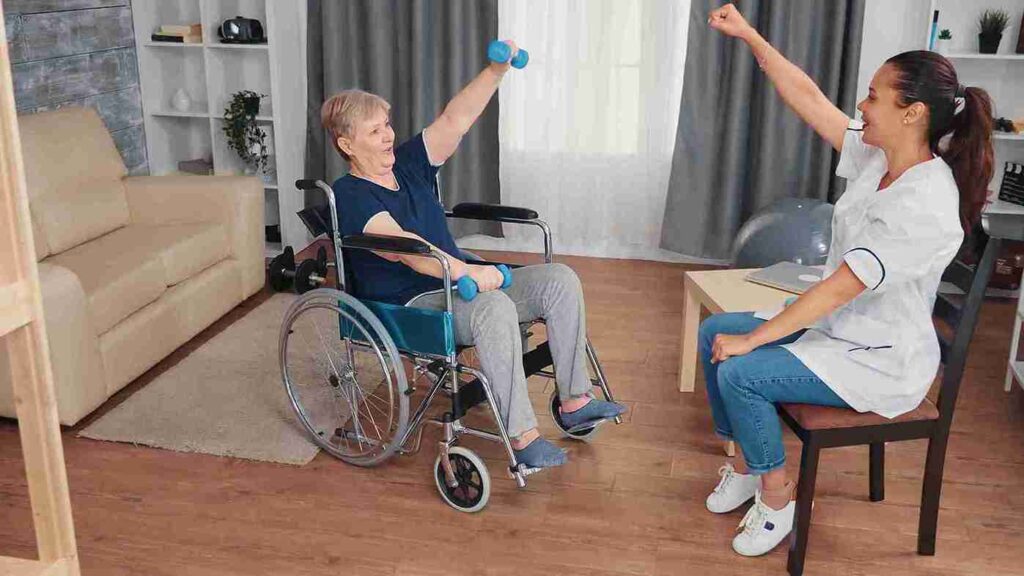
- Arms up, arms down. Raise both arms slowly overhead, then lower them. Repeat 4 or 5 times, matching your pace to theirs.
- Shoulder rolls. Slow circles, forward then back. Demonstrate alongside them the whole time.
- Hands together, gentle squeeze. Palms pressed together at chest height, a light squeeze and release. Simple, tactile, easy to repeat.
Keep this same sequence for weeks or months if it’s working. You can find more general chair yoga sequences in our chair yoga routine builder if you want to explore beyond this one, though for dementia care, sticking with something familiar usually beats variety.
Making it part of the day
- Anchor it to something that already happens, the same way you would with any other routine. Right after breakfast tends to work well, since mornings are often a calmer window before fatigue sets in later in the day.
- Keep sessions short and end on a good note. It’s better to stop after three good minutes than push to ten and end on frustration.
- Bring in music if it helps. A familiar, calm song playing quietly in the background can make the session feel more like a shared moment and less like a task.
- Don’t measure success by the poses. A session where they smiled once, or seemed a little more settled afterward, counts as a good one, even if half the poses never happened.
When to loop in a professional
Reach out to a doctor, an occupational therapist, or a chair yoga instructor experienced with dementia care if:
- There’s been a recent fall or a new mobility change
- Sessions consistently cause agitation rather than calm
- You want structured, in-person guidance for adapting movements as the disease progresses
The Alzheimer’s Association has a helpful general guide on structuring daily activities for someone with dementia, and the National Institute on Aging has a similar resource on adapting activities as needs change. Both are useful beyond chair yoga specifically.
FAQ for Chair yoga for dementia
How is this different from regular chair yoga?
Fewer poses, more repetition, and far more focus on calm and connection than on the movement itself. The routine matters more than variety here.
What if they refuse to participate?
Don’t push. Try again at a different time of day, or just sit and do the movements yourself nearby. Sometimes watching for a few days is what opens the door to joining in.
Can this replace their regular exercise or therapy?
No. Think of it as one gentle addition to their day, not a substitute for anything a doctor or therapist has recommended.
What if they can’t follow the movements at all anymore?
That’s common as dementia progresses. At that point, simple hand-holding, gentle stretching you guide for them, or just sitting together with calm music may be more appropriate than an active routine. A physical or occupational therapist can help you figure out what still fits.
Related reading: How to guide a parent or loved one through chair yoga · Chair yoga breathing techniques for seniors · Chair yoga for seniors: the complete guide