Chair yoga for lower back pain is one of the most searched topics by seniors and one of the most effective solutions available.
The fix isn’t complicated either. But it requires consistency.
Chair yoga for back pain works because it addresses all 3 causes at once: it strengthens the muscles that support the spine, stretches the ones that are pulling on it, and trains the body to move in ways that protect the back during everyday life.
This guide covers 9 chair yoga poses for back pain, what the research says, and a 15-minute daily routine you can start today.
Table of Contents
What the research actually says
The evidence for chair yoga for lower back pain is stronger than most people realise.
A randomized controlled trial published in PubMed studied 131 older adults with lower extremity osteoarthritis. The chair yoga group attended twice-weekly 45-minute sessions for 8 weeks. They showed significantly greater reduction in pain interference compared to the control group, and the benefits were sustained 3 months after the programme ended.
A separate 2024 study from Cleveland Clinic ran a 24-week randomized clinical trial with 140 participants with chronic low back pain. Average pain scores dropped significantly. The researchers concluded yoga is a safe, effective option for chronic lower back pain.
And a 2024 study in PMC specifically tracking women with chronic low back pain found that after just 8 yoga sessions, average pain scores dropped from 6.8 to 3.3 on a 10-point scale. More than halved.
Chair yoga for back pain isn’t a gentle alternative to real treatment. For many seniors, it is the treatment.
Why lower back pain gets worse without movement
This is the part most people get backwards.
When the back hurts, the instinct is to rest. Stop moving. Wait for it to pass. But inactivity causes the muscles supporting the spine to weaken further, the joints to stiffen, and the pain cycle to continue.
Movement — the right kind, done gently and consistently — breaks that cycle. Chair yoga for lower back pain specifically targets:
- The core: the deep abdominal and back muscles that act as a natural brace for the spine
- The hip flexors: chronically tight in anyone who sits a lot, and a leading driver of lower back pain
- The spinal extensors: the muscles running alongside the spine that maintain posture and prevent compression
- The piriformis: a small muscle in the glutes that, when tight, pulls on the sciatic nerve and causes lower back and hip pain
All 9 poses are below target in at least one of these.
9 chair yoga for lower back pain
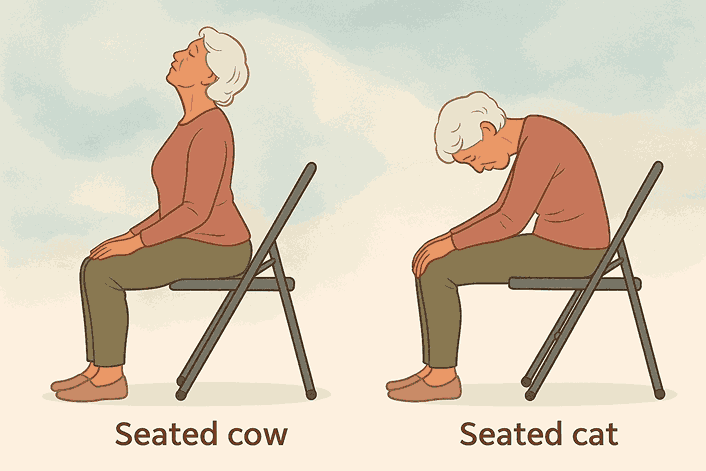
1. Cat-Cow (Marjaryasana-Bitilasana)
Targets: spinal flexibility, disc decompression, morning stiffness
Sit upright, hands on knees. Inhale and arch the spine — chest forward, gaze slightly up (Cow). Exhale and round the spine — chin to chest, back rounding outward (Cat). Move slowly with the breath. 10 rounds.
This is the single most effective daily movement for spinal health. It pumps fluid into the spinal discs, maintains range of motion, and relieves the compression that builds from prolonged sitting. Do it every morning before you stand up.
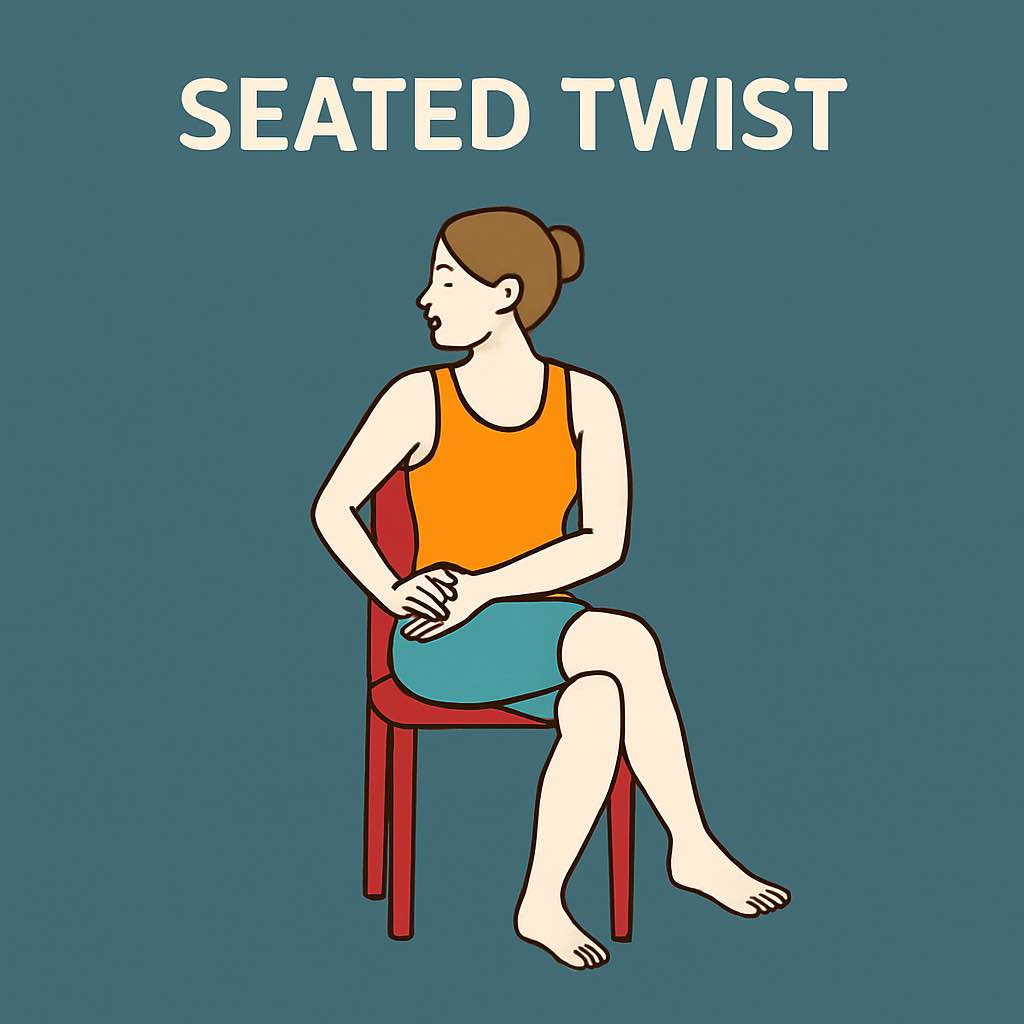
2. Seated Spinal Twist (Ardha Matsyendrasana)
Targets: spinal rotation, lower back tightness, obliques
This is one of the most underused chair yoga for lower back pain poses in most senior programmes.
Sit tall, feet flat. Place your right hand on your left knee and your left hand on the back of the chair. Inhale to lengthen the spine, exhale and gently rotate left. Hold 20–30 seconds, breathing slowly. Switch sides.
The spine is designed to rotate. Most seniors lose this range of motion without realising it. Every degree of rotation you lose in the spine gets compensated for by extra stress on the lower back joints. This pose maintains that rotation directly.
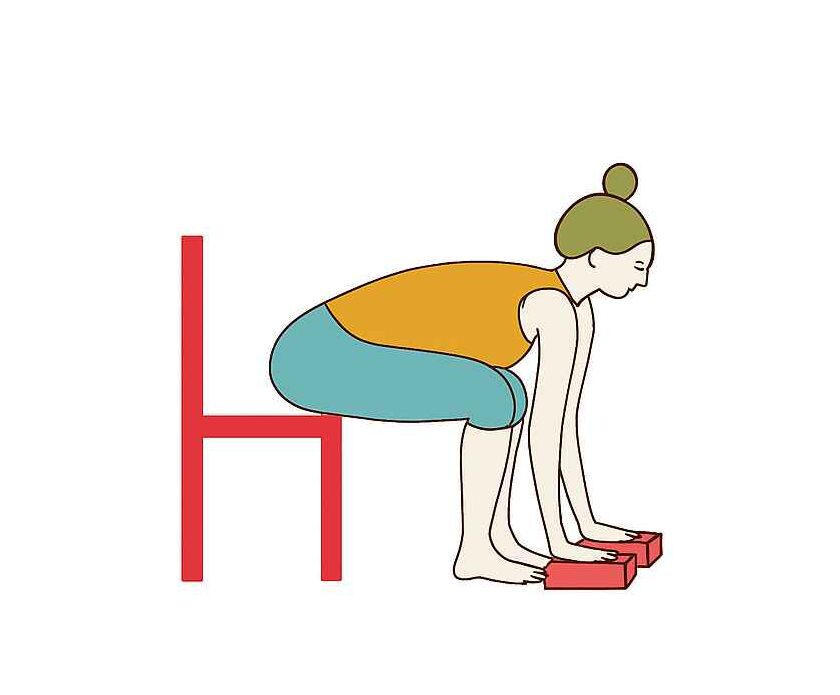
3. Seated Forward Fold (Paschimottanasana)
Targets: hamstrings, lower back, decompression
Sit at the edge of the chair, legs extended forward, feet flexed. Hinge from the hips and fold forward, letting the hands reach toward the feet or rest on the shins. Hold 30–45 seconds.
Tight hamstrings are one of the most overlooked causes of lower back pain. When the hamstrings can’t lengthen, the pelvis tilts backward, flattening the lumbar curve and loading the lower back discs unevenly. This pose addresses that directly.
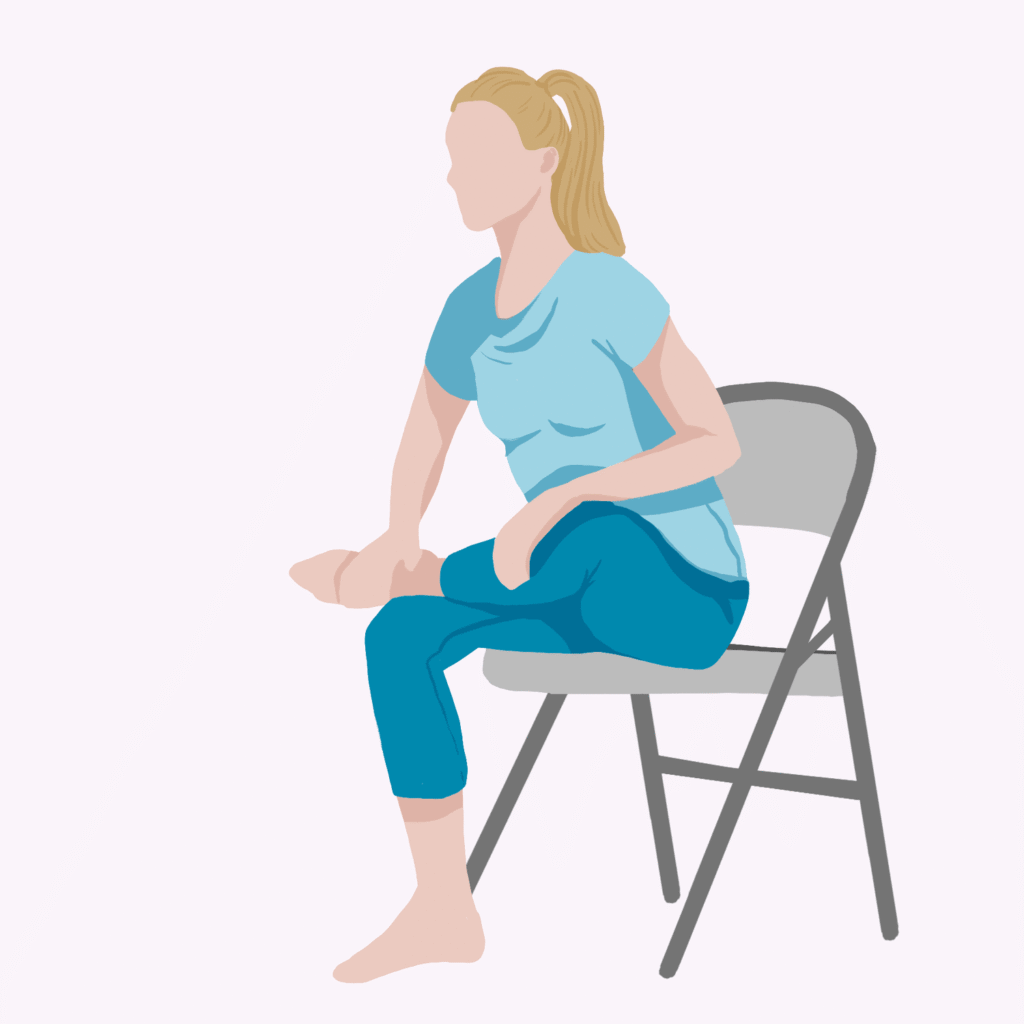
4. Figure-Four Stretch (Chair Pigeon)
Targets: piriformis, hip rotators, sciatica-related back pain
Cross one ankle over the opposite knee, flex the foot. Gently press down on the bent knee. Sit tall and lean forward slightly until you feel a stretch in the outer hip and glute. Hold 30–45 seconds. Switch sides.
The piriformis sits directly next to the sciatic nerve. When it tightens, which happens with prolonged sitting, it can compress the nerve and cause radiating pain into the lower back, hip, and leg. This stretch releases it. If you’re managing sciatica specifically, our chair yoga for sciatica guide covers this in more detail.
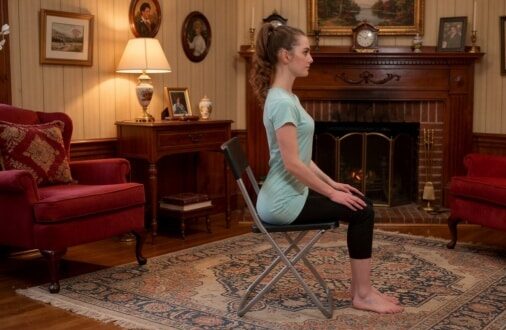
5. Seated Mountain with Pelvic Tilt (Tadasana)
Targets: lumbar curve, core activation, posture
Pelvic awareness is the foundation of all chair yoga for lower back pain work.
Sit at the edge of the chair, feet flat. Tilt the pelvis forward slightly so the lumbar curve deepens (anterior tilt). Hold 5 seconds. Tilt backward, flattening the curve (posterior tilt). Hold 5 seconds. Repeat 10 times, ending in neutral.
Most chronic lower back pain involves either a loss of the lumbar curve (too flat) or an exaggeration of it (too arched). This movement trains awareness of pelvic position, which is the foundation of every other movement in daily life.
6. Seated Child’s Pose (Modified Balasana)
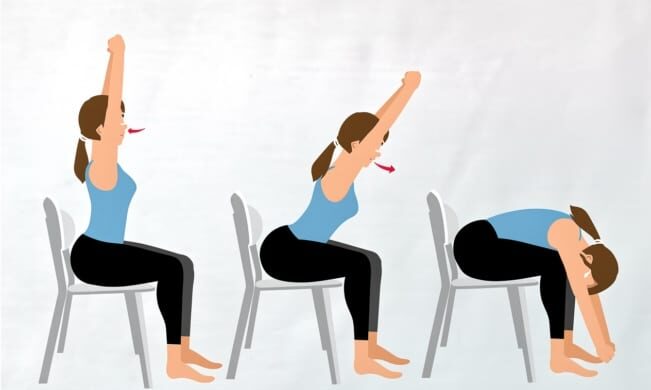
Targets: lower back decompression, hip flexors, relaxation
Sit at the edge of the chair, feet wide apart. Fold forward between your knees, letting your chest drop toward your thighs. Arms can hang or rest on the floor. Hold 45–60 seconds.
This position lengthens the entire posterior chain, the back muscles from skull to heels, while taking all load off the spine. It’s the most effective rest position for acute lower back pain. If your back is flaring, start here.
7. Seated Leg Raises (Core Activation)
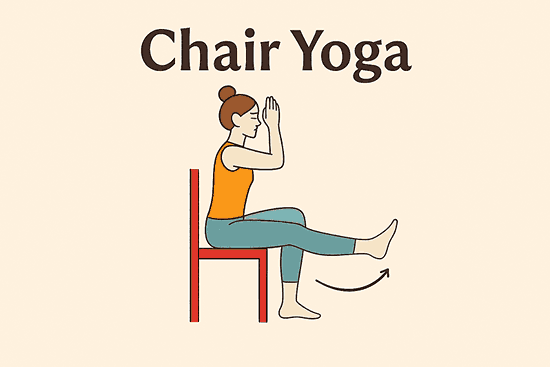
Targets: deep core, hip flexors, lumbar stabilisers
Sit tall, hands on the sides of the chair. Slowly lift one knee toward your chest, hold for 3 seconds, and lower slowly. Alternate legs. 10 reps each side.
The core muscles that protect the lower back, specifically the transverse abdominis and the multifidus, are almost always weakened in people with chronic back pain. This activates both without putting any compressive load on the spine.
8. Seated Cow Face Arms (Gomukhasana Arms)
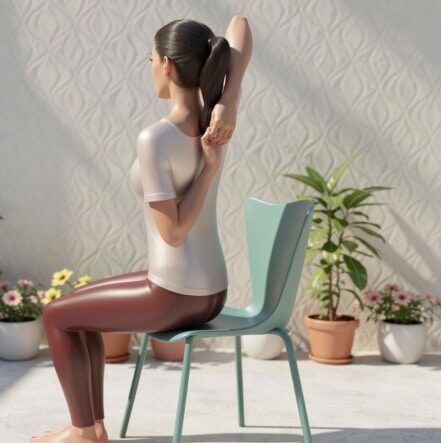
Targets: upper back, shoulders, thoracic spine
Sit tall. Raise your right arm, bend the elbow, and reach the hand down your upper back. Reach the left arm behind your back and up, trying to clasp fingers (use a strap or towel if needed). Hold 20 seconds. Switch sides.
Upper back and shoulder tightness pulls the thoracic spine into a rounded position, which compensates for the lower back. This releases the muscles that cause that rounding. Particularly useful for anyone who spends time at a computer or in a recliner.
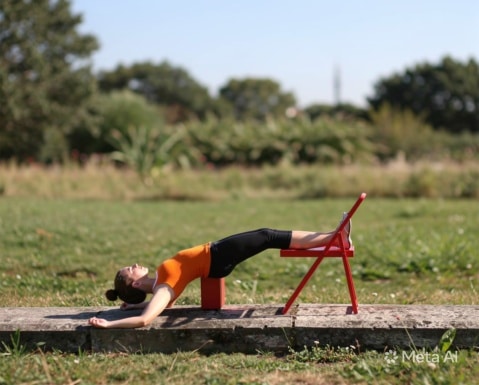
9. Supported Bridge (Modified Setu Bandha Sarvangasana)
Targets: glutes, lumbar extensors, hip flexors
Sit at the very edge of the chair, feet flat and hip-width apart. Press through the feet, engage the glutes, and lift the hips up and slightly forward. Hold for 5–10 seconds, lower slowly. 8 reps.
Weak glutes are behind more lower back pain than most people realize. The glutes are supposed to absorb shock and stabilize the pelvis with every step. When they’re weak, the lower back compensates. This exercise strengthens them directly, in a completely safe seated position.
Your 15-minute daily routine for back pain
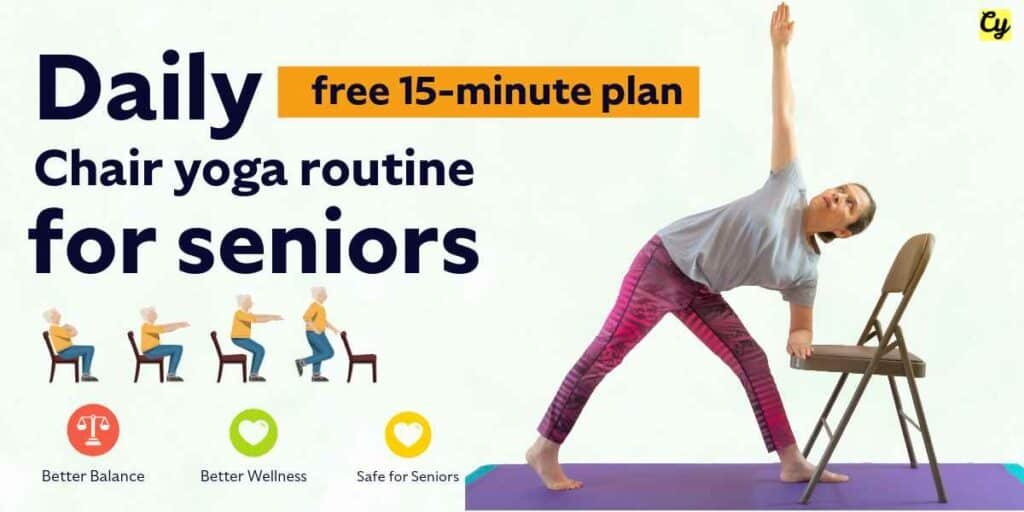
Do these in order. The sequence matters; it moves from mobility to activation to strength.
This is your complete chair yoga for lower back pain routine. Do it every morning without skipping.
Minutes 1–3:
- Cat-Cow: 10 slow rounds
Minutes 3–7:
- Seated Spinal Twist: 30 seconds each side
- Figure-Four Stretch: 45 seconds each side
Minutes 7–10:
- Seated Forward Fold: 45 seconds
- Seated Child’s Pose: 60 seconds
Minutes 10–15:
- Seated Mountain with Pelvic Tilt: 10 reps
- Seated Leg Raises: 10 reps each side
- Supported Bridge: 8 reps
- Seated Cow Face Arms: 20 seconds each side
Do this every morning. The 15-minute window before you start moving around for the day is when the back is stiffest and most responsive to gentle movement.
For a full structured programme, our free 28-day chair yoga challenge incorporates back pain poses progressively across 4 weeks.
What to avoid if you have back pain
A few things that make chair yoga for lower back pain less effective or potentially harmful:
- Deep twists done with force. Twists should be gentle and breath-led. Never crank or pull yourself further into a rotation.
- Rounded forward folds with a flexed spine. If you have a disc issue or osteoporosis, avoid bending forward with a rounded back. Hinge from the hips with a long spine instead.
- Holding your breath. Breath-holding creates intra-abdominal pressure that spikes spinal load. Breathe slowly throughout every pose.
- Doing too much too soon. Start with the first 5 poses. Add the rest over 2 weeks as your back adapts.
If you have a diagnosed condition like a herniated disc, spinal stenosis, or severe osteoporosis, check with your doctor before starting. And if back pain is accompanied by leg weakness, loss of bladder or bowel control, or severe radiating pain, see a doctor before doing any exercise.
How chair yoga for lower back pain connects to your other routines
Back pain and balance are connected. A weak core contributes to poor balance, and poor balance leads to falls that can worsen back injuries. Our balance exercises for seniors guide covers this overlap in detail.
And if you’re managing arthritis alongside back pain, our chair yoga for health conditions page has specific modifications for both.
For a printable version of this routine to keep on your wall or fridge, download our free printable chair yoga for seniors.
Frequently asked questions
How long does chair yoga take to help back pain?
The Cleveland Clinic 24-week trial showed significant improvement over months of consistent practice. The PMC study showing pain drop from 6.8 to 3.3 achieved that in 8 sessions across 4 weeks. Most people notice reduced stiffness within 1–2 weeks of daily practice. Significant pain reduction typically takes 4–8 weeks.
Can chair yoga replace physiotherapy for back pain?
For mild to moderate chronic back pain, chair yoga has shown comparable results to some physiotherapy programmes in research settings. For acute injury, post-surgical recovery, or severe disc issues, physiotherapy should come first. Chair yoga is an excellent maintenance and prevention tool alongside medical care.
Which chair yoga pose is best for lower back pain specifically?
Cat-Cow for daily maintenance. Figure-Four for piriformis and sciatic-related lower back pain. Supported Bridge for strengthening the glutes that support the lumbar spine. If you only do 3 poses, do those 3.
Is chair yoga safe for back pain caused by arthritis?
Yes. The PubMed randomised controlled trial cited above specifically studied older adults with osteoarthritis. Chair yoga showed significantly greater pain reduction than the control group, with a 95% session retention rate, meaning people kept showing up because it helped.
Can I do chair yoga for lower back pain every day?
Yes. Unlike high-intensity exercise, chair yoga for back pain can and should be done daily. The movements are gentle enough that daily practice builds cumulative benefit without causing overuse injury.
The bottom line
Chair yoga for lower back pain works. The research is there. The mechanism is clear.
15 minutes every morning. The 9 poses above. Consistent for 4 weeks.
That’s the whole prescription. No equipment. No gym. No getting on the floor.
Start with Cat-Cow tomorrow morning before you get out of bed. 10 rounds. See how your back feels the rest of that day.