


The question: how many calories should a 70-year-old woman eat? Most 70-year-old women need 1,600–2,200 calories a day — here’s the range, the exact formula, and a full day of eating that fits it.
Quick answer: most 70-year-old women need between 1,600 and 2,200 calories per day — roughly 1,600 if life is quiet and sedentary, and up to about 2,200 with regular activity. The honest number depends on height, current weight, muscle mass, and how much you move, which is why the answer below takes two minutes to personalize instead of one second to guess.
Want your exact number instead of a range? Our free calorie calculator computes it from your age, height, weight, and activity in ten seconds — and shows a senior-friendly protein target alongside.
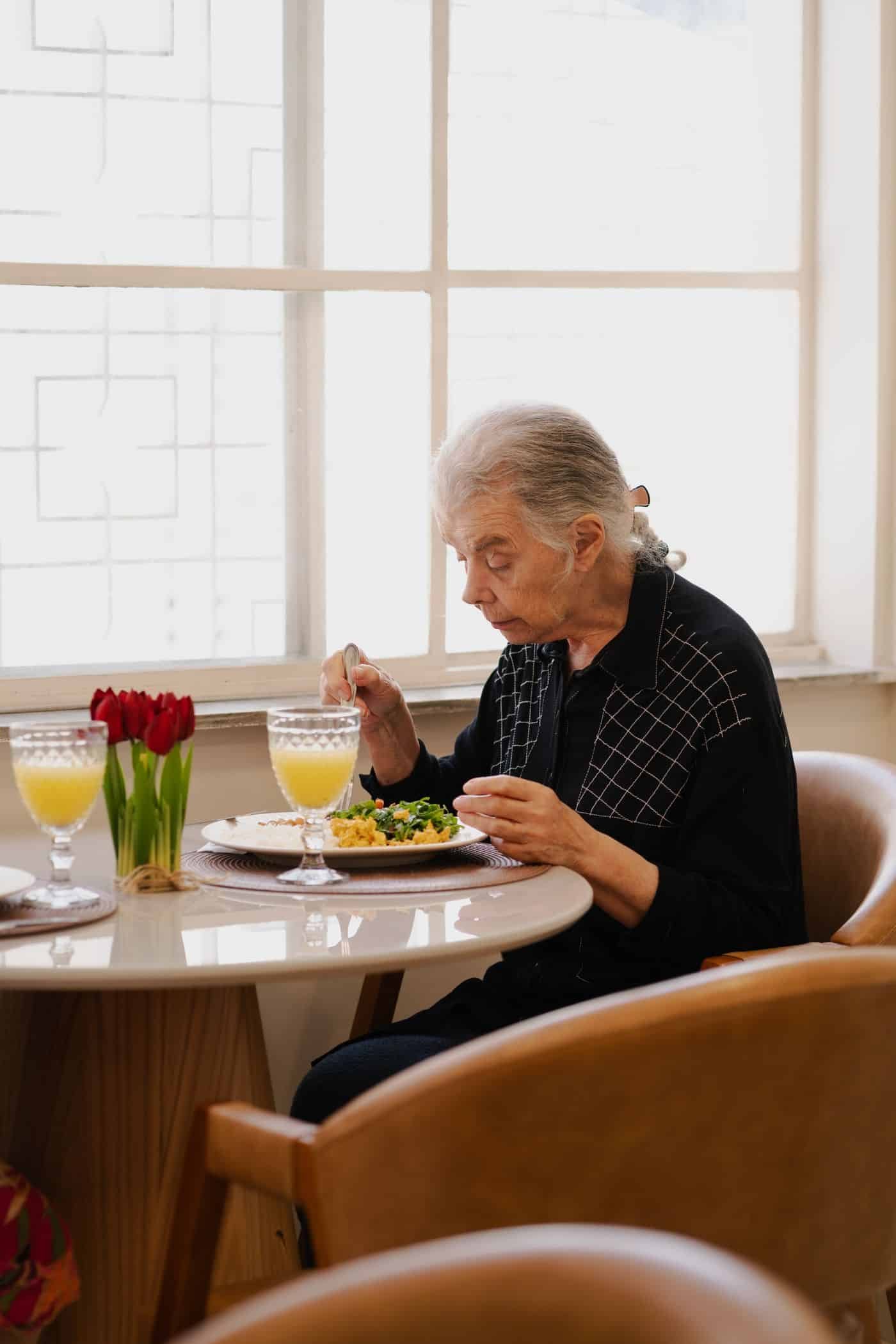
Calorie needs for a 70-year-old woman: the ranges
| Lifestyle at 70 | Calories per day (130–160 lb woman) | What it looks like |
|---|---|---|
| Sedentary | 1,500–1,700 | Mostly seated days, short walks, no formal exercise |
| Lightly active | 1,700–1,900 | Daily walks or easy movement 1–3 days a week |
| Moderately active | 1,900–2,100 | Exercise or long walks most days, active errands |
| Very active | 2,100–2,300 | Hard exercise 5+ days a week or physical hobbies |
Three caveats make any table more of a starting line than an answer:
- Body size. A 120 lb woman needs several hundred fewer calories than a 180 lb woman of the same age and activity. The table’s middle column assumes an average build.
- Height. Taller bodies burn more at rest, at every age.
- Health status. Illness, recovery from surgery, and some medications push needs in either direction. Your doctor or a registered dietitian should confirm targets when a medical condition is in play.
Why do calorie needs fall after 70?
The number drops for two compounding reasons. First, muscle mass declines — a process called sarcopenia that accelerates after 60. Muscle is metabolically expensive tissue, so as it thins, resting burn falls with it. Second, everyday movement quietly shrinks: steps get shorter, housework gets paced out, and hobbies turn sedentary. The two effects together trim roughly 5–10% of calorie needs per decade after 40, so a woman who held her weight at 1,900 calories at 55 may gain slowly at 1,800 by 70.
The National Institute on Aging covers this decline in detail in its guidance on healthy eating for older adults, along with the nutrient traps that come with a shrinking calorie budget.
The exception: metabolism is not ruined at 70
Research published in Science in 2021, analyzing doubly labeled water data from more than 6,400 people, found that metabolism holds remarkably steady between ages 20 and 60 and only then begins a gradual decline (Pontzer et al., 2021). So the drop after 70 is real but modest — roughly 1% per year at most — and the muscle-and-movement factors above explain most of what women experience. Translation: the number moves less than most people fear, and strength work and protein can push it back up.
The formula: calculate your personal number
Ranges become precise with the Mifflin-St Jeor equation, the standard for estimating resting calorie burn:
- BMR (women): 10 × weight (kg) + 6.25 × height (cm) − 5 × age − 161
- Daily calories: BMR × activity multiplier (1.2 sedentary to 1.9 very active)
For a 70-year-old woman who is 5’4″, weighs 150 lb and walks most days (lightly active), the equation produces about 1,750 calories per day for weight maintenance. Same woman, mostly seated: closer to 1,600.
You don’t need to do that arithmetic — the calorie calculator runs it for you and adds a protein target, a BMI reading, and a gentle movement estimate calibrated for 60+. If your goal is holding your weight once you find the number, the maintenance calorie calculator shows the stability band around it and a two-week weigh-in protocol that confirms the estimate against your real body.
What a day of eating looks like at 1,600–1,800 calories
Hitting a number matters less than what the calories are made of. After 70, every meal needs to pull weight: nutrient density and protein carry the plan.
| Meal | Example | Calories | Protein |
|---|---|---|---|
| Breakfast | 2 scrambled eggs, whole wheat toast, orange | ≈ 380 | 19 g |
| Lunch | Tuna sandwich, vegetable soup | ≈ 430 | 28 g |
| Snack | Greek yogurt with berries | ≈ 160 | 15 g |
| Dinner | Baked salmon, roasted potatoes, green beans | ≈ 520 | 34 g |
| Snack | Apple with a few almonds | ≈ 190 | 5 g |
| Total | ≈ 1,680 | ≈ 101 g |
That protein total is deliberate. Adults over 65 do best near 1.2 g of protein per kg of body weight per day — about 75–85 g for most women — because it defends the muscle that keeps metabolism and independence upright. Our protein calculator for seniors computes your exact target and ranks foods by how efficiently they hit it.
Signs your calorie intake is off — either direction
Eating too little after 70
- Losing weight without trying (a warning sign at this age, never a trophy)
- Frequent fatigue, dizziness on standing, or feeling cold
- Slow wound healing, more infections, hair thinning
- Losing strength: jars, stairs, and getting off the floor feel harder
Unplanned loss deserves a doctor’s visit, not just a bigger plate — some medical causes mimic diet effects.
Eating too much (the slow-gain pattern)
- Clothes tightening without bigger portions — drinks, oils, and snacks quietly supply 200–300 extra calories
- Post-meal sleepiness that lasts hours
- Heartburn returning
Slow gain at a stable eating pattern usually means maintenance has drifted downward with activity. Recalculate, don’t just cut harder: the gaining weight after 60 guide walks through the full diagnosis.
Should a 70-year-old woman try to lose weight?
Sometimes yes — excess weight stresses knees, hips, blood sugar, and balance — but the method must respect the decade. Three rules change the game after 70:
- Small deficits only. Eat 10–15% below maintenance, never crash levels. The calorie deficit calculator sizes this and enforces a floor of 1,200 calories with a safety warning.
- Protect protein and strength. Hold the 1.2 g/kg protein line and keep moving — chair exercises for seniors keep muscles working while calories drop.
- Slow beats fast. Half a pound a week is a fine pace at 70. Faster loss digs into muscle, bone and balance, and the fall risk outweighs the mirror benefit.
If weight sits in a healthy range and the goal is simply staying there, eat at maintenance — daily chair yoga adds a modest burn and keeps joints honest without touching the diet.
Calorie needs at 65, 75 and 80: how the number moves
| Age (160 cm / 5’3″, 68 kg / 150 lb, lightly active) | Maintenance calories | Change from 55 |
|---|---|---|
| 55 | ≈ 1,870 | — |
| 65 | ≈ 1,800 | −70 |
| 70 | ≈ 1,765 | −105 |
| 75 | ≈ 1,730 | −140 |
| 80 | ≈ 1,695 | −175 |
The decade-long drift is gentler than most people expect — about 100–150 calories from 55 to 75 — but it compounds with activity changes, which is where real-world gain comes from. Recalculating every couple of years keeps the target honest.
Frequently asked questions
Is 1,200 calories enough for a 70-year-old woman?
Rarely. 1,200 is the lowest adult intake any mainstream guideline endorses, and it suits only smaller, very sedentary women under close supervision. After 70, eating that little raises the risk of muscle loss, nutrient gaps, dizziness and falls. If weight loss is the goal, a mild deficit from a higher base loses fat while keeping strength.
How many calories should a 70-year-old woman eat to lose weight?
Take your maintenance number and subtract 10–15% — usually a target around 1,400–1,600 for a typical-sized woman — for a loss pace of roughly half a pound per week. Keep protein high, keep moving, and check in with your doctor first if you manage any chronic conditions.
Do calorie needs change after 70 if weight stays the same?
They drift down slowly with age alone, but activity and muscle shifts usually drive bigger changes. If weight is stable, your current intake is your current maintenance — the calculator simply documents it and the two-week weigh-in protocol confirms it.
How much protein should a 70-year-old woman eat daily?
About 1.2 g per kg of body weight — roughly 75–90 g for most women — spread across meals rather than loaded into one. Fish, eggs, dairy, beans and lentils cover it comfortably at calorie levels above 1,500.
What if I’m underweight at 70 — should I eat more?
Yes, deliberately: add 300–500 calories a day from nutrient-dense sources — nuts, olive oil, whole dairy, avocados — plus gentle strength work so the gain lands as muscle. Underweight at this age carries higher health risk than mildly overweight, so treat gain as a project worth doing properly.
How many calories should a 70-year-old man eat?
Mostly 2,000–2,600 per day depending on size and activity — about 400–500 more than a woman of the same age, because men carry more muscle and are typically larger. The calculator above handles men with the same inputs.
Tools and guides that pair with this article
- Calorie Calculator — your exact daily number with BMI and senior-friendly macros
- Maintenance Calorie Calculator — the number that holds your weight, with a ±100 stability band
- Calorie Deficit Calculator — if weight loss is the goal, size it safely
- Protein Calculator for Seniors — the 1.2 g/kg muscle-defense target
- Water Intake Calculator — thirst fades with age; check your hydration
- Daily Chair Yoga Routine — a 10-minute movement habit that keeps burn up
- Chair Yoga for Bad Knees — gentle movement that respects joints
- 28-Day Chair Yoga Challenge — build the habit with a printable chart