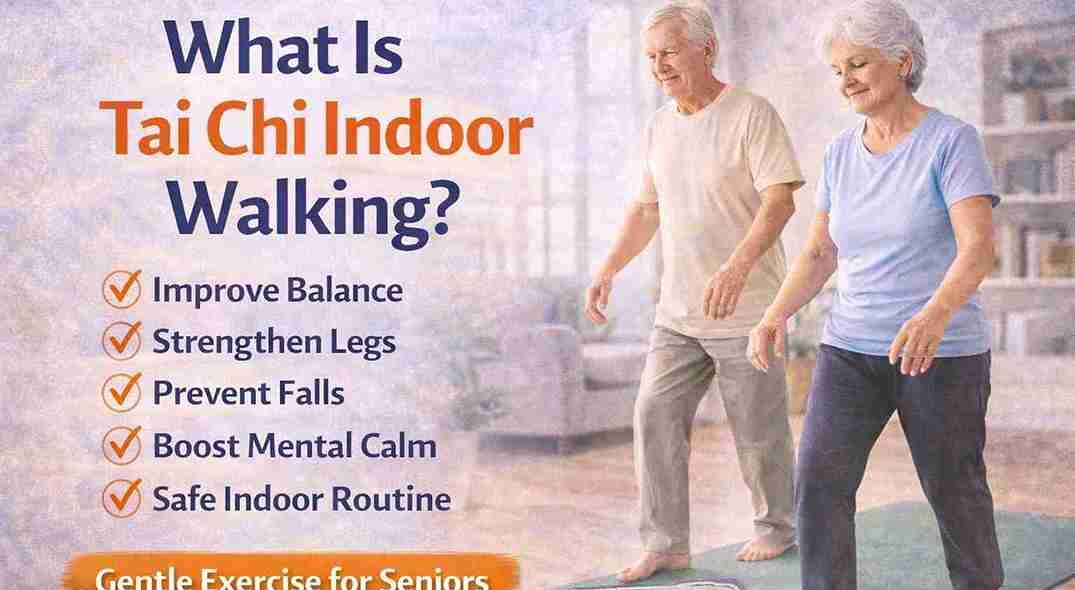
If you’ve recently heard the term “tai chi indoor walking,” you might be wondering:
- Is it regular walking?
- Is it tai chi?
- Is it safe for seniors?
The answer: It’s a gentle combination of slow, mindful walking movements inspired by tai chi principles, designed to improve balance, coordination, and stability, especially indoors.
For adults over 60, indoor tai chi walking offers a safe way to:
- Improve balance
- Strengthen legs
- Reduce fall risk
- Increase mobility
- Calm the mind
And best of all, it can be done safely at home.
Table of Contents
What Is Tai Chi?
Tai chi is a traditional Chinese mind-body exercise involving the following:
- Slow, flowing movements
- Controlled breathing
- Weight shifting
- Balance training
It is widely studied for senior health benefits.
A systematic review published on PubMed confirmed tai chi significantly improves balance and reduces fall risk in older adults. Study link
Another large meta-analysis found tai chi reduces falls by up to 43% in seniors. Study link
These results are powerful.
How to Do Tai Chi Indoor Walking (Step-by-Step)
This 10-minute beginner routine is safe and simple.
Step 1: Stand Tall
- Feet hip-width apart
- Knees slightly bent
- Shoulders relaxed
- Chin slightly tucked
Step 2: Slow Heel-to-Toe Step
- Lift one foot slowly
- Place heel down first
- Roll foot gently to toes
- Shift weight gradually
Move slowly. Control matters more than speed.
Step 3: Coordinate Arms
As you step, the opposite arm moves forward. Keep movement soft and relaxed.
Step 4: Breathe Slowly
Inhale as you step forward. Exhale as you shift weight.
Step 5: Continue for 5–10 Minutes
Walk in a straight line. Turn slowly. Repeat.
Video demonstration
What Makes Tai Chi Indoor Walking Different?
Traditional tai chi includes choreographed movement sequences.
Tai chi indoor walking simplifies those principles into the following:
- Slow heel-to-toe walking
- Controlled weight transfer
- Upright posture
- Gentle arm movements
- Coordinated breathing
It removes complex choreography. This makes it easier and safer for seniors.
Why Indoor Walking?
Indoor walking is ideal for seniors because
- No uneven surfaces
- No weather risks
- No traffic
- Reduced fall hazards
- Controlled environment
It’s especially useful for seniors who:
- Have limited mobility
- Fear outdoor falls
- Live in colder climates
- Use walkers or support
Science-Backed Benefits of Tai Chi Indoor Walking
1. Reduces Fall Risk
Falls are the leading cause of injury in adults over 65. Research confirms tai chi reduces fall risk significantly. Study link
The reason: tai chi improves proprioception (body awareness), balance, leg strength, and reaction time. Indoor walking builds those same skills safely.
2. Improves Balance and Stability
A randomized controlled trial found tai chi improved postural stability in seniors after 12 weeks. Study link
Indoor walking trains controlled weight shifts, heel-to-toe stability, and center-of-gravity control, all critical for preventing falls.
3. Strengthens Leg Muscles
Tai chi increases lower-body strength. Research confirms tai chi improves knee extensor strength and overall lower limb function. Study link
Indoor walking mimics this through slow, controlled stepping, weight transfer, and muscle engagement.
4. Improves Cognitive Function
Tai chi has been shown to improve cognitive function and reduce mental decline. Study link
The slow, mindful nature of tai chi indoor walking engages focus, improves coordination, and stimulates the brain-body connection.
5. Reduces Anxiety and Stress
Tai chi reduces stress and improves mood. Study link
The breathing and slow rhythm calm the nervous system.
6. Improves Joint Mobility
Tai chi improves joint range of motion without strain. This is especially helpful for seniors with arthritis, knee stiffness, or hip discomfort.
7. Safe for Limited Mobility
Tai chi indoor walking is low-impact, gentle, slow-paced, and customizable. It can be done along a hallway, in a living room, or near a wall for support.

Myth vs Reality: What the Research Actually Says
Most articles cite the same handful of studies without examining what those studies actually measured. Here’s a closer look:
| Myth | Reality |
|---|---|
| “Tai chi reduces falls by 43%” | That meta-analysis measured formal tai chi practice over 12–24 weeks with trained instructors not casual indoor walking inspired by tai chi principles. The simplified version hasn’t been studied in isolation. |
| “10 minutes daily is enough” | Most cited studies used 45–60 minute sessions, 2–3 times weekly. The 10-minute claim is a practical simplification, not a direct research finding. |
| “It’s safe for everyone over 60” | Study participants typically excluded people with acute cardiovascular conditions, severe osteoporosis, or recent joint surgery. Not every senior fits the studied population. |
| “Slower is always better” | Excessively slow movement can actually increase balance difficulty since it demands more control. This can be therapeutic for some, but risky for beginners with poor core stability. |
| “No equipment needed” | A stable wall or counter for support isn’t optional for many seniors — it’s a practical safety requirement, not an afterthought. |
Takeaway: The research behind tai chi is strong, but it applies most directly to structured, longer, instructor-led programs. Indoor walking is a reasonable, lower-barrier adaptation, not a substitute with identical guaranteed results.
How Often Should Seniors Practice?
Recommended:
- 10–15 minutes daily
- Or 3–5 times weekly
Research suggests improvements in 8–12 weeks.
Who Should Try Tai Chi Indoor Walking?
Ideal for seniors who:
- Fear falling
- Have mild balance issues
- Want gentle cardio
- Prefer low-impact exercise
- Practice chair yoga
It pairs very well with chair yoga routines.
When Tai Chi Indoor Walking Doesn’t Work (And What To Do Instead)
Tai chi indoor walking isn’t universally effective. Recognizing when the standard approach doesn’t fit is just as important as learning the steps.
| Situation | Why the standard routine falls short | What to do instead |
|---|---|---|
| Vestibular disorders (inner ear issues) | Slow heel-to-toe transitions can worsen dizziness | Try a modified stationary weight-shifting version before attempting walking |
| Severe peripheral neuropathy | Reduced foot sensation means the heel-to-toe roll provides little proprioceptive feedback | Add visual feedback, such as practicing in front of a mirror |
| Post-stroke, one-sided weakness | The even, symmetric cadence doesn’t match unequal strength/control | Use an asymmetric step timing adjusted to the stronger and weaker side |
| Progress plateaus after 8–12 weeks | Most guides imply endless linear improvement | This is expected plateaus signal it’s time to add complexity, not quit |
| Thick carpet flooring | Makes the heel-to-toe roll harder to execute correctly, contrary to assumptions that carpet is “safer” | Practice on a firm, flat surface, or adjust step technique for the surface |
Key insight: If the basic routine feels wrong or ineffective, that’s often a signal to modify the approach for your specific condition, not a sign you’re doing it incorrectly.

The Progression Framework: From Week 1 to Month 6
A single static routine caps how much benefit a practitioner can gain over time. Progression matters.
| Phase | Focus | What changes |
|---|---|---|
| Weeks 1–2 | Foot mechanics only | Practice the heel-to-toe roll near a wall, without adding arm coordination yet |
| Weeks 3–4 | Add arm coordination | Only introduce arm movement once foot mechanics are automatic |
| Month 2 | Add turns and direction changes | Move beyond a straight line to build broader balance capacity |
| Months 3–4 | Reduce support reliance | Gradually step away from the wall/counter — this is the real progress marker |
| Months 5–6 | Light dual-tasking | Add simple cognitive tasks (see Advanced Layer section below) to further challenge balance and coordination |
Key insight: “Doing the routine longer” isn’t the same as progressing. Real improvement comes from deliberately increasing complexity in stages.
Combine Tai Chi Indoor Walking With Chair Yoga
Chair yoga improves strength and flexibility. Tai chi indoor walking improves balance and coordination. Together they create a complete fall-prevention system.
For structured routines, see: Gentle Yoga & Mobility Guide for Stiff Joints, Balance & Daily Comfort
It includes chair yoga, balance drills, gentle mobility flows, and recovery methods.
Hidden Variables That Change Everything: Footwear, Flooring, and Time of Day
These practical details rarely appear in basic guides, but they often determine whether a session is safe and effective.
| Variable | Common mistake | Better practice |
|---|---|---|
| Footwear | Practicing barefoot or in loose socks on hardwood | Use grip socks or thin, flat-soled shoes to reduce slip risk |
| Time of day | Doing a full-speed routine right after waking | Start with a slower, shorter first 2–3 minutes to account for morning joint stiffness |
| Medication timing | Practicing immediately after blood pressure medication | Wait 1–2 hours after morning medication to reduce dizziness from orthostatic drops |
| Lighting | Practicing in dim rooms | Ensure bright, even lighting — reduced visual cues significantly affect senior balance |
| Rugs and mats | Assuming a yoga mat or rug adds safety/comfort | Remove any surface with an edge; it becomes a trip hazard during heel-to-toe steps |
Key insight: Two people doing the “same” routine can have very different levels of safety and effectiveness depending on these overlooked environmental factors.
Safety Tips
- Practice near a wall or counter
- Wear non-slip shoes
- Keep floor clear
- Avoid rushing
- Stop if dizzy
If severe balance issues exist, consult a doctor.
Printable Tai Chi Indoor Walking Routine
Your printable PDF includes:
- Step-by-step instructions
- Safety checklist
- Weekly tracker
- Progress guide
This makes consistency easier.
Common Mistakes to Avoid
- Walking too fast
- Locking knees
- Leaning forward
- Holding breath
- Practicing on slippery floors
Slow, controlled movement is key.
Advanced Layer: Combining Tai Chi Walking With Cognitive Dual-Tasking (For Established Practitioners)
This section is for readers who have already built a consistent 8–12 week foundation. It is not intended for beginners.
Dual-tasking, adding a light cognitive load while walking, is the actual mechanism believed to drive much of the fall-reduction research. Single-task slow walking has diminishing returns once the basics are mastered.
How to introduce dual-tasking safely:
- Confirm readiness first; you should be able to complete 10 minutes of the base routine with zero wall contact and no visible wobble on turns.
- Start with simple cognitive additions: counting backward by 7s, naming a category of items (fruits, cities) while stepping.
- Try rhythm mismatches: tapping a hand rhythm that’s intentionally out of sync with your steps, which challenges divided attention.
- Avoid surface perturbation tools (such as standing on a folded towel or foam pad) without professional supervision; these appear in some advanced routines online but carry real fall risk for unsupervised seniors.
- If form breaks down when a cognitive task is added, drop the task and return to single-task practice; this is a normal part of the learning curve, not a failure.
Readiness checklist:
- 10 minutes of base routine completed with no wall support
- No visible wobble during turns
- Comfortable with arm coordination and breathing pattern
- No dizziness or fatigue during or after sessions
- At least 8 weeks of consistent practice completed
Conclusion for What Is Tai Chi Indoor Walking
So, what is tai chi indoor walking?
It’s a simplified, safe, science-backed walking practice inspired by tai chi principles designed to improve balance, reduce falls, and support healthy aging.
For seniors over 60, it offers:
- Gentle movement
- Stronger legs
- Better stability
- Improved confidence
- Reduced injury risk
Just 10 minutes a day can make a powerful difference, and understanding when to modify the routine, how to progress it, and which hidden variables matter most will make that difference even greater.
FAQs for What Is Tai Chi Indoor Walking
What is tai chi indoor walking? It is a slow, mindful walking exercise based on tai chi principles, designed to improve balance and reduce fall risk.
Is tai chi indoor walking safe for seniors? Yes, for most seniors. Research confirms tai chi improves balance and reduces falls in older adults, though certain conditions (vestibular disorders, recent joint surgery, and severe osteoporosis) require a modified approach; see “When Tai Chi Indoor Walking Doesn’t Work” above.
How often should seniors do tai chi walking? 10–15 minutes daily or 3–5 times per week, with progression added over 8–12 weeks.
Does tai chi really reduce falls? Yes, though the strongest evidence comes from longer, instructor-led programs rather than short casual sessions. See the Myth vs Reality section for details.
Can I do tai chi walking at home? Yes. It is designed for safe indoor practice; paying attention to flooring, footwear, and lighting will make it safer still.