

Free Printable Chair Yoga for Seniors with Pictures is one of the most practical ways to help older adults stay active, flexible, and pain-free without leaving their comfort zone. For many seniors, traditional yoga on the floor can be intimidating, especially with issues like arthritis, balance concerns, or limited mobility. Chair yoga bridges that gap. It adapts classic yoga poses into gentle, safe, and senior-friendly movements you can perform while seated or using a sturdy chair for support.
In this guide, you’ll learn why chair yoga is so effective, see step-by-step descriptions of poses, understand the benefits backed by science, and download a free printable PDF with pictures that you can keep beside your chair as a daily practice reminder.
Table of Contents
Why Chair Yoga is Ideal for Seniors
Yoga is often associated with advanced postures and flexibility, but its core philosophy is adaptability. Chair yoga is built on that principle: it takes movements that promote health and modifies them for a body that may need extra support.
Here’s why chair yoga is an excellent fit for seniors:
- Safety first – There’s no need to get down on the floor, reducing the risk of falls.
- Accessibility – Seniors with arthritis, knee issues, or hip replacements can still enjoy yoga without strain.
- Stress relief – Gentle stretches combined with deep breathing calm the mind, lowering anxiety and stress.
- Better circulation – Moving joints and muscles improves blood flow, reducing stiffness and swelling.
- Boosted independence – By improving mobility, seniors can maintain daily activities like walking, reaching, or bending.
Science backs this up:
A 2018 study in the Journal of the American Geriatrics Society found that chair yoga significantly reduced pain and improved mobility in older adults with osteoarthritis.
A 2020 review in the International Journal of Yoga showed chair yoga helps lower stress and improves sleep quality.
The CDC recommends older adults include balance and flexibility training — exactly what chair yoga provides — to reduce the risk of falls.
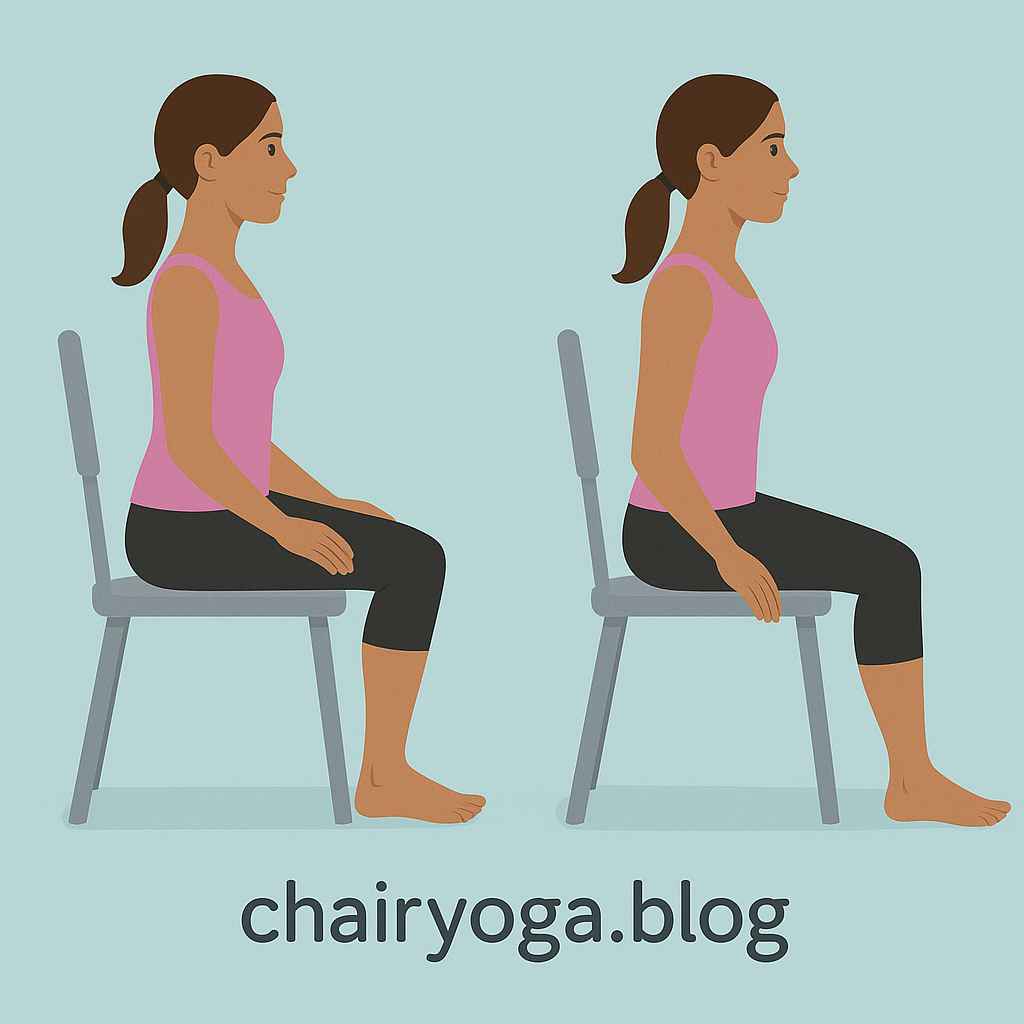
Free Printable Chair Yoga for Seniors with Pictures
We’ve created a free printable PDF that includes step-by-step poses with clear illustrations. This makes it simple for seniors to follow along without needing a video or app. The PDF includes a 15-minute daily routine, modifications for arthritis and COPD, and safety tips.
Before diving into the routine, let’s look at the core poses you’ll find in the printable guide.
1. Seated Mountain Pose (Tadasana)
This is the foundation of all yoga poses. It builds posture awareness and sets the tone for mindful breathing.
- Sit tall in a sturdy chair with feet flat on the floor.
- Place hands on your thighs or let them rest at your sides.
- Roll shoulders back and down, lift your chest, and lengthen your spine.
- Inhale deeply, feeling your belly expand. Exhale slowly.
Benefits: Improves posture, focus, and lung capacity.
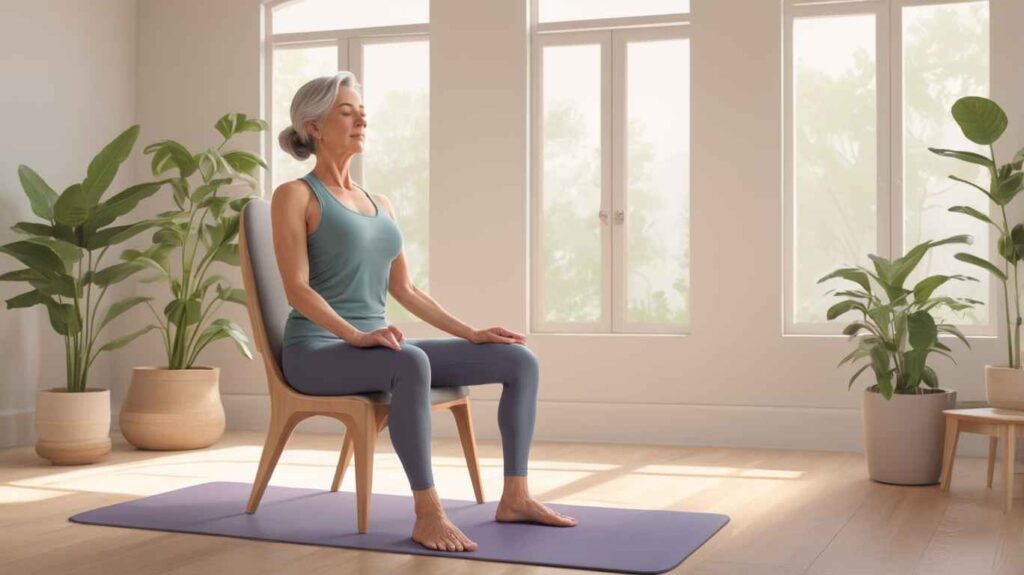
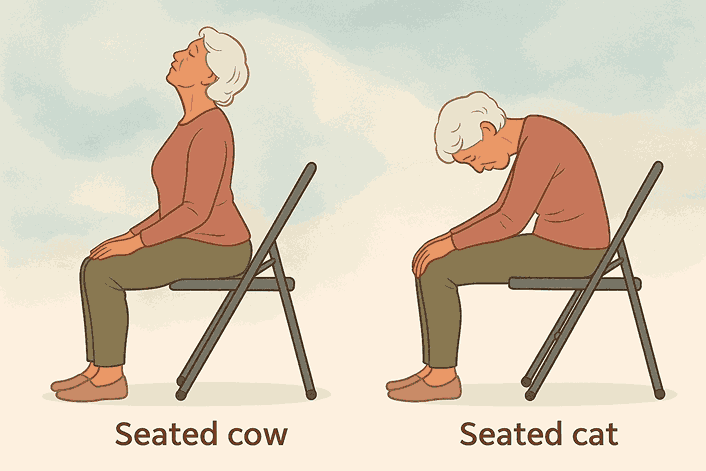
2. Seated Cat-Cow Stretch (Marjaryasana-Bitilasana)
A gentle flow between two poses that keeps your spine flexible and relieves stiffness.
- Sit with feet flat, hands on knees.
- Inhale: arch your back slightly, lift your chest, and gaze upward (cow).
- Exhale: round your back, tuck your chin, and draw belly inward (cat).
- Repeat 5–8 times.
Benefits: Eases back pain, improves spinal flexibility, and aids digestion.
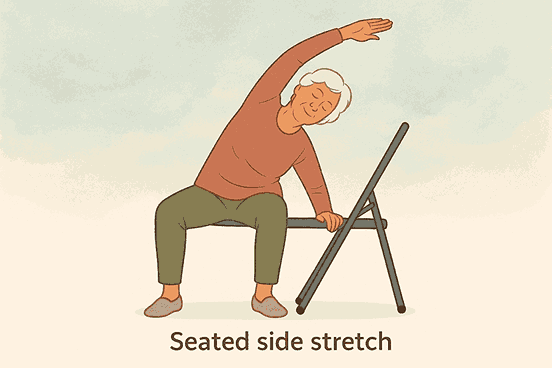
3. Seated Side Stretch
Helps open up the ribcage and improve breathing capacity.
- Sit tall with feet flat.
- Place left hand on the chair seat, raise right arm overhead.
- Lean gently to the left, feeling a stretch along your side.
- Hold for 3–5 breaths, then switch sides.
Benefits: Expands lung capacity, improves spinal flexibility, and reduces stiffness in the waist.
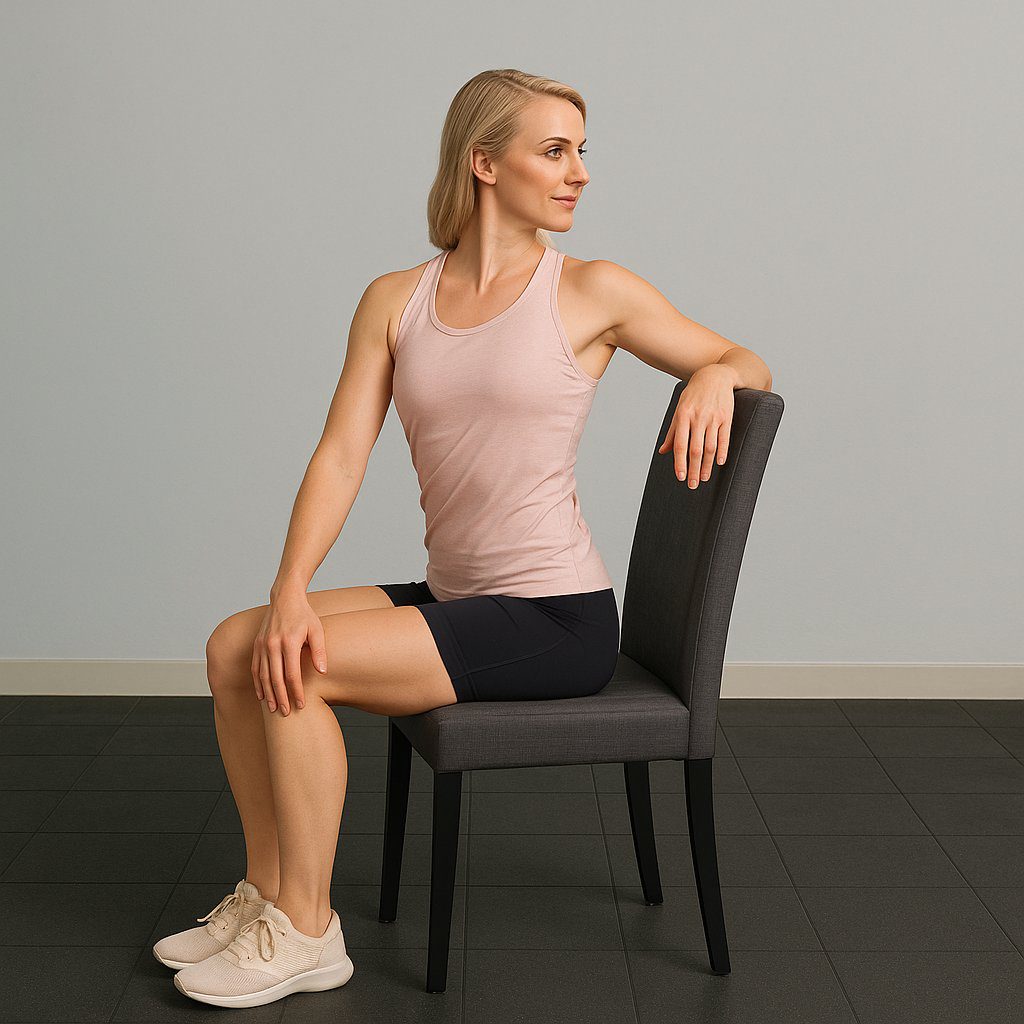
4. Seated Twist (Ardha Matsyendrasana Variation)
Encourages gentle spinal rotation and stimulates digestion.
- Sit tall with feet hip-width apart.
- Place right hand on the chair’s back or armrest.
- Inhale to lengthen spine, exhale to twist gently to the right.
- Hold 3–5 breaths, then switch sides.
Benefits: Aids digestion, enhances spinal mobility, reduces back stiffness.
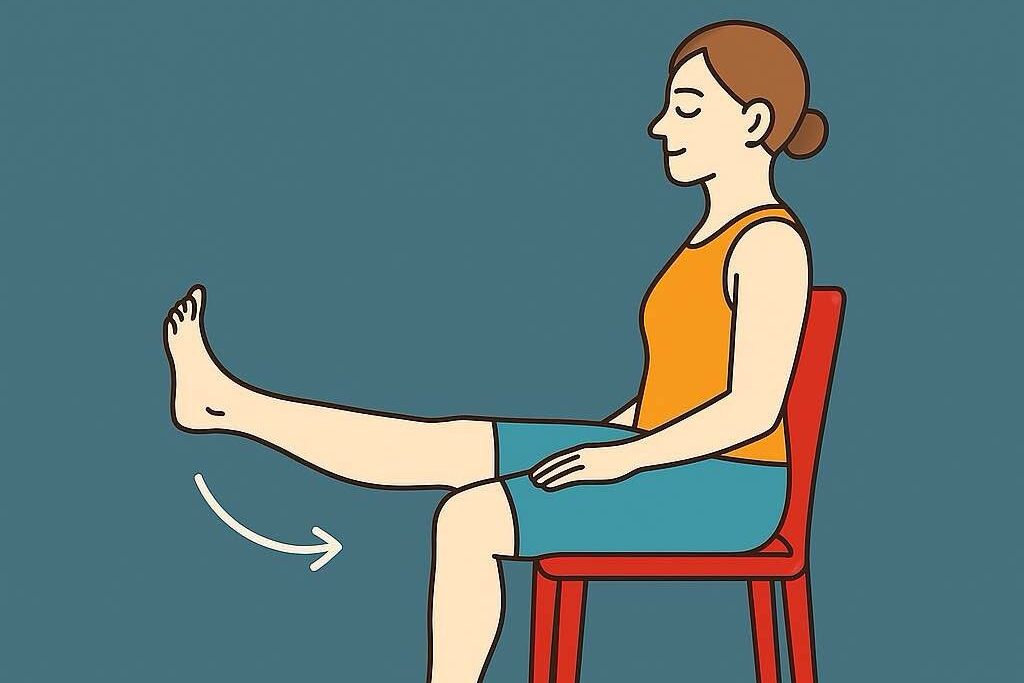
5. Seated Leg Extensions
Strengthens lower body without strain.
- Sit near the edge of the chair, feet flat.
- Extend right leg straight, keeping thigh engaged.
- Hold for 2–3 breaths, then lower.
- Repeat 8–10 times each leg.
Benefits: Builds thigh and knee strength, supports walking stability.
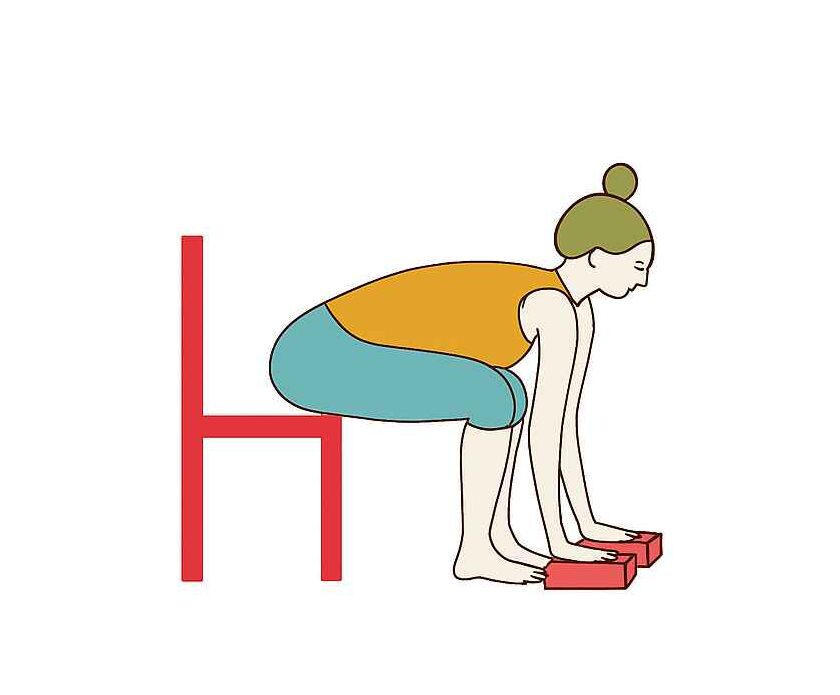
6. Seated Forward Bend (Paschimottanasana Variation)
Calms the mind and lengthens the back.
- Sit tall, feet hip-width apart.
- Exhale and slowly hinge forward at hips.
- Let hands reach toward knees, shins, or ankles.
- Hold for 5 breaths.
Benefits: Relieves stress, stretches spine, and improves circulation.
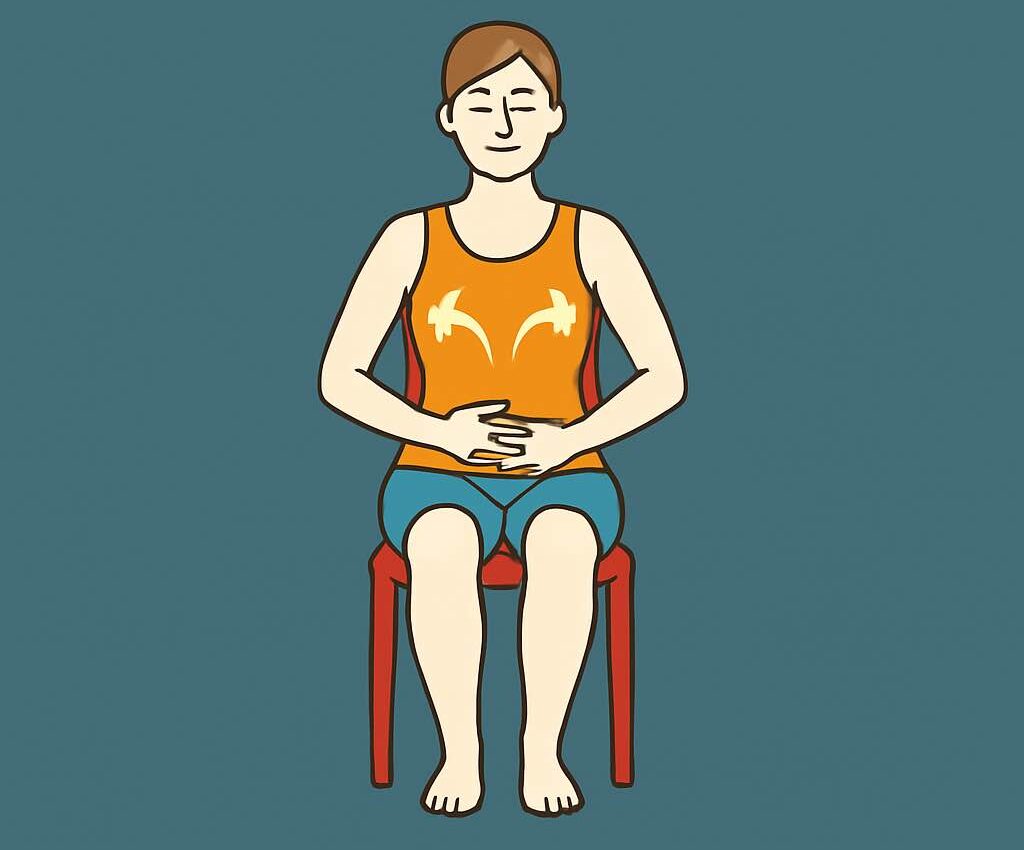
7. Seated Relaxation and Breathing
End your practice with calmness.
- Sit comfortably, close your eyes.
- Inhale deeply through the nose, exhale slowly.
- Rest hands on your thighs.
- Stay here for 2–3 minutes.
Benefits: Lowers blood pressure, calms the nervous system, improves sleep.
Why some seniors feel dizzy during chair yoga
A surprising number of seniors feel lightheaded during chair yoga.
Usually during:
- deep breathing
- leaning forward
- standing up afterward
And honestly, it scares people.
I’ve seen seniors stop exercising entirely after one dizzy episode because they thought something dangerous happened.
Sometimes it’s serious.
A lot of times it isn’t.
The body just reacts differently after 60.
Free pdf
📥 Don’t forget to download your free printable chair yoga PDF with pictures.
Print it, place it by your chair, and enjoy a healthier, happier routine every day.
Standing up too fast changes blood pressure quickly
This happens constantly.
A senior finishes seated stretches, stands up immediately, then suddenly grabs the chair because the room feels “floaty.”
Blood pressure shifts faster than the body adjusts.
The Cleveland Clinic orthostatic hypotension guide explains this well.
Older adults often need a few seconds between:
- sitting
- standing
- walking
That pause matters.
Deep breathing can make some people lightheaded
Slow breathing helps many seniors relax.
But some people accidentally hyperventilate while trying to “breathe deeply.”
You can usually spot it fast:
- shoulders lifting too high
- fast inhale
- forceful exhale
- dizziness after 4 or 5 breaths
Gentle breathing works better.
Quiet breathing.
Soft breathing.
The kind where the chest barely moves.
Morning chair yoga feels harder for certain people
The morning body is weird.
Stiffer joints.
Lower hydration.
Slower circulation.
And medications haven’t fully kicked in yet for some people.
I’ve noticed many seniors do better after:
- a glass of water
- breakfast
- 5 minutes of walking around the house
Early-morning forward bends can feel rough otherwise.
Some medications quietly change balance
This gets overlooked all the time.
Blood pressure medications.
Sleeping pills.
Diuretics.
Even allergy medication sometimes.
The Mayo Clinic healthy aging exercise guide talks about medication-related fatigue and dizziness in older adults.
A senior might blame the chair yoga when the bigger issue is medication timing.
Certain symptoms deserve medical attention
A little lightheadedness after movement can happen.
These symptoms deserve attention quickly:
- chest pressure
- fainting
- confusion
- severe instability
- numbness
- slurred speech
Chair yoga should leave someone calmer and looser afterward.
Not frightened.
Why printable chair yoga works better than videos for many seniors
People assume video workouts automatically work better.
I don’t think that’s true for a lot of seniors.
Videos move too fast sometimes.
Even “beginner” yoga videos can feel like:
- constant instructions
- camera angle changes
- background music
- talking without pauses
That’s mentally tiring.
A printed routine beside the chair feels calmer.
Too much instruction overwhelms people
This happens more after 60.
Especially when:
- memory changes
- hearing declines
- focus gets shorter
- anxiety increases
The National Institute on Aging cognitive health guide discusses how aging changes information processing speed.
A printable page removes the pressure to “keep up.”
People can pause naturally.
Pictures reduce hesitation
You can see this instantly with beginners.
The second someone understands:
- where hands go
- how the spine should look
- where feet belong
…their confidence improves.
Pictures reduce uncertainty.
And uncertainty drains energy fast in older adults.
Printed routines become physical reminders
This matters more than people think.
A printed PDF sitting beside the chair becomes:
- a visual cue
- a habit trigger
- part of the daily environment
That physical visibility keeps routines alive.
Apps disappear into phones.
Printed pages stay visible.
Simpler layouts improve follow-through
Over-designed yoga printables usually perform worse.
Too many:
- colors
- arrows
- text blocks
- anatomy explanations
…becomes visual clutter.
The best senior printables are boring in a good way.
Large pictures.
Big text.
Clear instructions.
Done.
Chair yoga mistakes that quietly increase joint pain
A lot of seniors think pain during chair yoga means they’re “doing exercise wrong.”
Sometimes the problem is smaller than that.
Usually it’s:
- pacing
- posture
- repetition volume
- forcing movement
Tiny adjustments change everything.
Arthritic joints hate aggressive stretching
This is probably the biggest mistake I see.
People pull too hard trying to “loosen up.”
Arthritic joints usually respond better to:
- smaller movement
- repetition
- warmth
- gradual motion
The Arthritis Foundation movement guide repeatedly recommends gentle movement over forceful stretching.
Pain the next morning usually means the body got irritated, not strengthened.
Twisting too far irritates sensitive spines
Seated twists are useful.
Aggressive twisting isn’t.
Especially for seniors with:
- osteoporosis
- spinal arthritis
- disc degeneration
A tiny twist often works better than a dramatic one.
Honestly, 20% movement quality beats 100% forced range.
Soft chairs wreck positioning
Couches are terrible for chair yoga.
People sink backward immediately.
Then:
- hips tuck under
- shoulders round
- neck strains forward
A firm dining chair usually works best.
Nothing fancy.
Long holds tire joints faster
Yoga culture loves long holds.
Older joints often don’t.
Especially knees and hips.
I’ve seen seniors tolerate:
- 5 gentle repetitions
…better than:
- 1 long static hold
Movement lubricates stiff joints better for many people.
Repeating exercises endlessly backfires
Some seniors think:
“If 10 repetitions helped, 30 must help more.”
Usually the joints disagree by the next morning.
Recovery capacity changes with age.
The body still adapts.
Just slower.
Myth vs reality: what chair yoga can actually do
| Myth | Reality |
|---|---|
| “Chair yoga cures arthritis” | It helps manage stiffness and movement tolerance |
| “Stretching fixes mobility” | Strength and coordination matter too |
| “Gentle exercise is ineffective” | Consistency changes the body gradually |
| “Seniors should avoid resistance work” | Muscle loss speeds up after 60 |
| “Pain always means damage” | Stiff tissues often become sensitive after inactivity |
| “One routine works for everybody” | Energy, balance, pain, and mobility vary a lot |
The CDC healthy aging resource talks constantly about balance, movement, and strength together.
Mobility changes slower after 60.
But it still changes.
That’s the encouraging part.
How seniors can safely progress beyond beginner chair yoga
Beginner chair yoga works well for the first few months.
Then something interesting happens.
The body adapts.
People suddenly notice:
- standing feels easier
- walking improves
- stiffness decreases
- getting out of chairs feels smoother
That’s usually the moment progression should start.
Slowly.
Weeks 1 to 4
The first month is mostly:
- consistency
- confidence
- learning movement patterns
That alone creates noticeable change in inactive seniors.
Especially with daily practice.
Months 2 to 3
This is where endurance starts improving.
You can usually add:
- longer marching
- more repetitions
- light standing support work
- balance drills near a countertop
Nothing dramatic.
Small increases work better.
Months 3 to 6
Now the body usually tolerates:
- resistance bands
- sit-to-stand exercises
- longer sessions
- walking combinations
This stage matters because muscle loss speeds up with age.
The Harvard Health exercise archive has years of reporting on this.
Strength protects independence.
That’s the real goal.
Recovery starts controlling progress
Younger people recover faster.
Older adults recover unpredictably sometimes.
Sleep quality matters more.
Hydration matters more.
Inflammation matters more.
Some weeks feel amazing.
Other weeks feel heavy.
That fluctuation is normal.
Stress and loneliness change movement more than people think
You can almost see stress in posture sometimes.
Tight shoulders.
Short breathing.
Rigid movement.
The nervous system changes movement quality constantly.
Fear after falls changes the body fast
After a fall, many seniors start moving cautiously all the time.
Tiny steps.
Rigid posture.
Less walking.
The body slowly loses confidence.
That fear pattern becomes physical.
Isolation reduces daily movement
The National Institute on Aging loneliness guide connects social isolation with worse physical health outcomes.
Retirement changes routines.
Grief changes routines.
Winter changes routines.
Movement shrinks quietly.
Gentle routines rebuild trust in movement
That’s part of why chair yoga works psychologically too.
A short daily routine reminds the brain:
- movement is safe
- balance still exists
- stiffness can improve
Confidence usually returns before strength does.
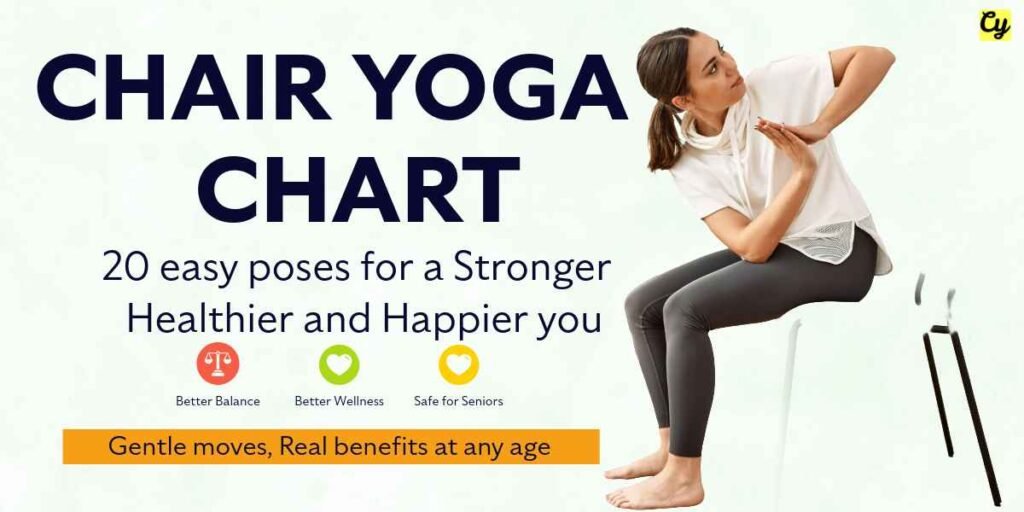
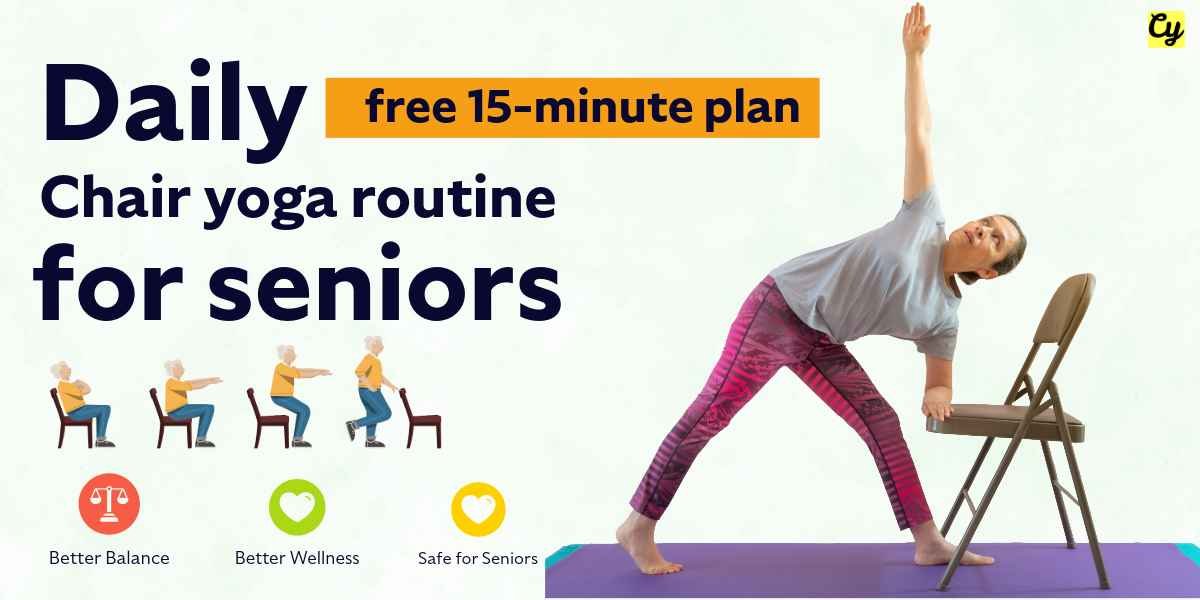
Daily Routine Plan (15–20 Minutes)
Your free printable chair yoga for seniors with pictures includes this structured daily routine:
- Seated Mountain Pose – 1 minute
- Cat-Cow Stretch – 2 minutes
- Side Stretch – 2 minutes per side
- Seated Twist – 2 minutes per side
- Leg Extensions – 3 minutes
- Forward Bend – 3 minutes
- Relaxation and Breathing – 3 minutes
This makes a perfect 15–20 minute chair yoga session you can practice daily.
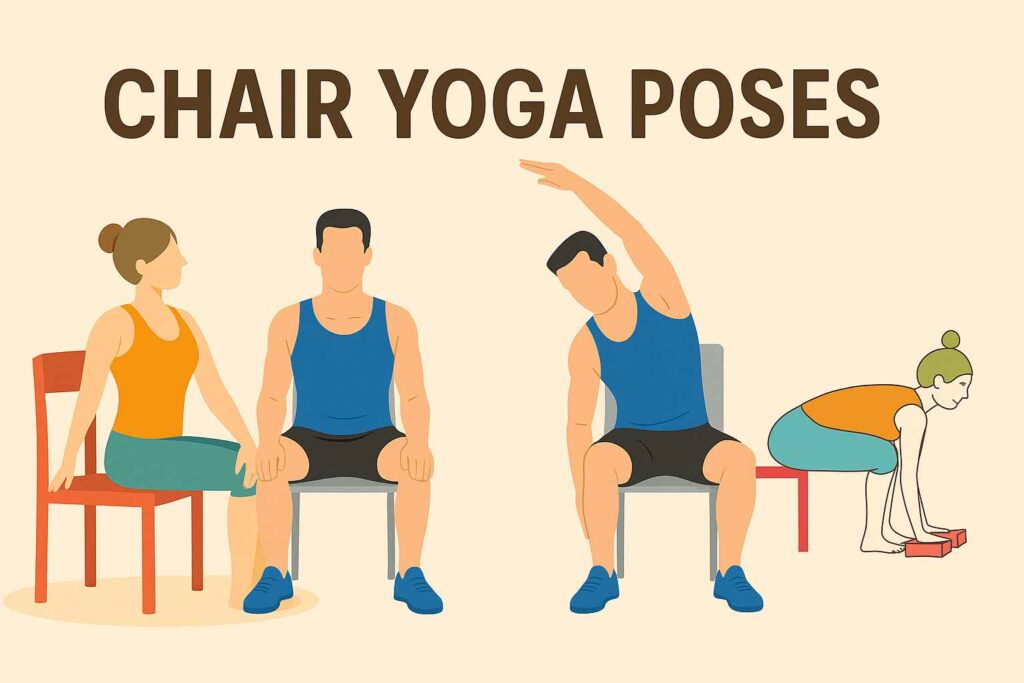
Benefits of Free Printable Chair Yoga for Seniors with Pictures
Visual guidance matters. Pictures make it easier for seniors to follow without overthinking instructions. Here’s what the practice offers:
- Flexibility & Mobility: Keeps joints moving, reduces stiffness.
- Balance & Stability: Builds leg strength, lowering fall risk.
- Pain Relief: Especially useful for arthritis, back pain, and hip discomfort.
- Stress Reduction: Breathing-focused yoga calms the nervous system.
- Improved Confidence: Seniors gain independence when they move more freely.
Common Mistakes to Avoid
Even simple movements can go wrong if rushed. Watch out for these:
- ❌ Using a chair with wheels — always choose a stable one.
- ❌ Holding breath during poses — remember to breathe naturally.
- ❌ Overstretching — movements should be gentle, never forced.
- ❌ Slouching — maintain posture as much as possible.
Who Should Avoid Chair Yoga?
Chair yoga is safe for most seniors, but consult a doctor first if you have:
- Severe osteoporosis
- Recent hip or knee surgery
- Uncontrolled high blood pressure
- Chronic dizziness or balance issues
With modifications, many seniors can still practice safely.
Science-Backed Evidence for Free Printable Chair Yoga for Seniors with Pictures
- 2018 study in the Journal of the American Geriatrics Society – Chair yoga improved pain management in seniors with osteoarthritis.
👉 Study Link - 2020 review in International Journal of Yoga – Seniors reported better sleep, lower stress, and reduced anxiety with chair yoga.
👉 Study Link - CDC Guidelines for Older Adults – Flexibility and balance activities like chair yoga are strongly recommended to prevent falls.
👉 CDC Link
FAQs on Free Printable Chair Yoga for Seniors with Pictures
Q1: How often should seniors do chair yoga?
Ideally, 15–30 minutes a day, at least 5 times per week.
Q2: Can chair yoga help with arthritis?
Yes. Chair yoga reduces joint stiffness and improves flexibility, making it one of the safest exercises for arthritis patients.
Q3: Is a printable PDF better than a video?
A printable PDF is easy to keep nearby and doesn’t require internet or screens. For best results, combine both.
Q4: Do I need any special equipment?
No. All you need is a sturdy chair without wheels. Optional: a strap or towel for stretches.
Q5: Can seniors with COPD or heart conditions practice chair yoga?
Yes, but consult a healthcare provider. Gentle chair yoga with breathing exercises can improve lung function and circulation.
Conclusion for Free Printable Chair Yoga for Seniors with Pictures
Free Printable Chair Yoga for Seniors with Pictures isn’t just an exercise routine — it’s a wellness tool that empowers seniors to live with less pain, more energy, and greater independence. With step-by-step pictures and a simple daily plan, anyone can start right away.
Even 15 minutes a day can make a noticeable difference in mobility, mood, and overall health. And the best part? You don’t need fancy equipment, a gym, or even a yoga mat, just a chair, your breath, and a willingness to start.
📥 Don’t forget to download your free printable chair yoga PDF with pictures.
Print it, place it by your chair, and enjoy a healthier, happier routine every day.








13 thoughts on “Free Printable Chair Yoga for Seniors with Pictures (11 Easy Poses + PDF)”
Where is the so-called free PDF?
Hi Catherin👋 The free printable PDF download link is available at the bottom of the article. Please scroll down to the end of the post, and you’ll find it there.
It’s a Word document with no photos.
We’ve updated the PDF! 🎉 You can now download it again—it includes proper pictures for easier reference. Sorry for any inconvenience earlier, and thank you for your patience!
I don’t have any money, only foodstamps
where is the download?
Hi Brenda 👋 The free printable PDF download link is available at the bottom of the article. Please scroll down to the end of the post, and you’ll find it there.
the download comes up as a word doc, not pdf and has no pictures
We’ve updated the PDF! 🎉 You can now download it again—it includes proper pictures for easier reference. Sorry for any inconvenience earlier, and thank you for your patience!
Thank you for posting this. It is greatly appreciated. I wish I had money to send. To show my gratitude but its a bad time right now. Have a great day and smile.
Your message means more than any donation ever could. 😊 I truly appreciate your kind words and support that’s what keeps me going! Wishing you better days ahead and sending a big smile your way. 💛
I carefully gave all my information on the chair Yoga’s website to download its printable chart FREE. After it was completed I was taken into the site to choose a plan at a specific cost for each. No opportunity to print the ‘chart FREE.
I consider this a bait and switch site.
Hi Marion, thanks for your feedback and sorry for the confusion. The free printable PDF is available at the bottom of the article under the *“Download Free PDF”* section. No purchase is required to access the free version. If the page experience made that unclear, we appreciate you pointing it out and we’ll work on making the download location easier to find.