
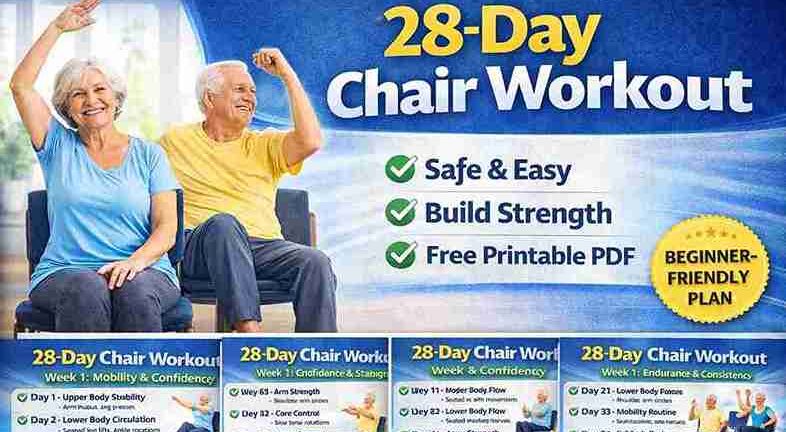
Try this 28 day chair workout designed for seniors and beginners. A safe, joint-friendly, free plan to improve strength, mobility, balance, and confidence, including a free printable PDF. 28 Day Chair Workout: A Safe, Simple & Beginner-Friendly Plan You Can Do at Home
Staying active should not feel painful, confusing, or risky, especially as we age.
That’s why a 28 day chair workout is one of the safest and most effective ways for seniors and beginners to improve strength, mobility, and confidence without standing exercises, heavy equipment, or gym memberships.
This guide gives you a complete 28-day chair workout plan, broken down day by day, so you always know exactly what to do.
Table of Contents
The Complete 28 Day Chair Workout Plan
Each week focuses on a specific goal so your body adapts safely.
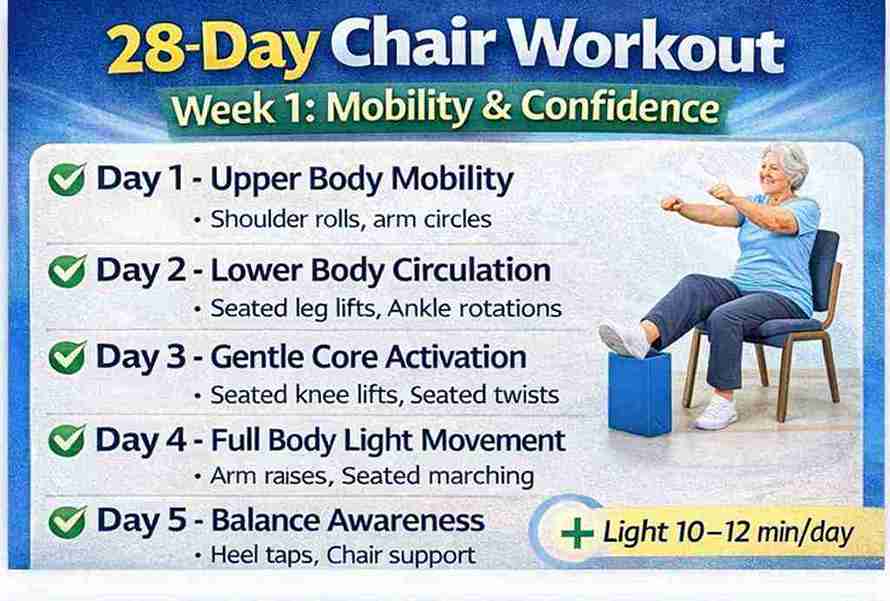
Week 1: Mobility & Confidence
Goal: Wake up joints and build confidence
Time: 10–12 minutes/day
Day 1 – Upper Body Mobility
- Shoulder rolls
- Arm circles
- Neck stretches
Day 2 – Lower Body Circulation
- Seated leg lifts
- Ankle rotations
- Heel taps
Day 3 – Gentle Core Activation
- Seated knee lifts
- Seated twists
Day 4 – Full Body Light Movement
- Arm raises
- Seated marching
Day 5 – Balance Awareness
- Heel-to-toe taps
- One-hand chair support
Day 6 – Stretch & Relax
- Seated forward bend
- Deep breathing
Day 7 – Rest or Light Stretch
✔ What you should feel:
Less stiffness, more comfort sitting and standing.
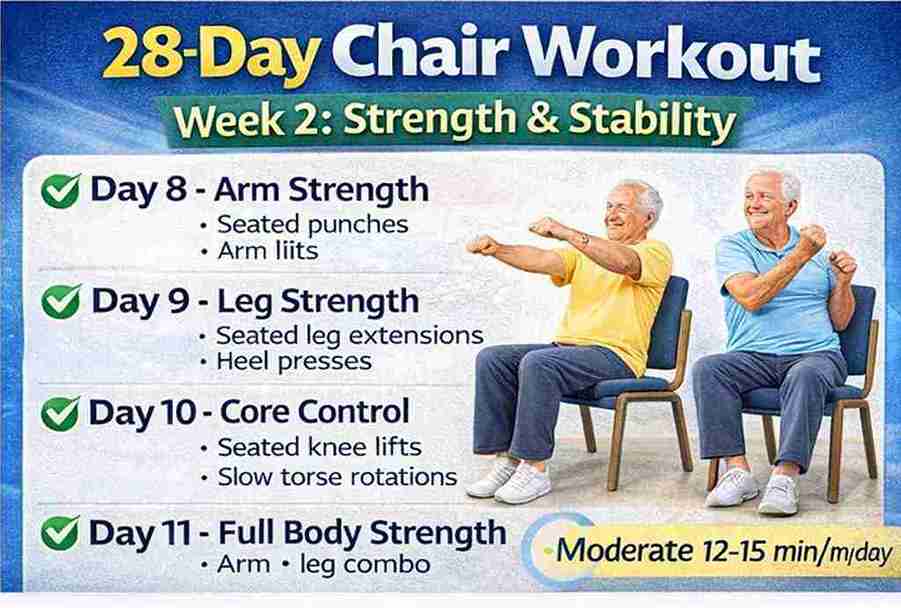
Week 2: Strength & Stability
Goal: Build muscle gently
Time: 12–15 minutes/day
Day 8 – Arm Strength
- Seated punches
- Arm lifts
Day 9 – Leg Strength
- Seated leg extensions
- Heel presses
Day 10 – Core Control
- Seated knee lifts
- Slow torso rotations
Day 11 – Full Body Strength
- Arm + leg combo movements
Day 12 – Balance Support
- Chair-assisted standing (optional)
- Weight shifts
Day 13 – Stretch & Recovery
Day 14 – Rest
✔ What you should feel:
More strength without soreness.
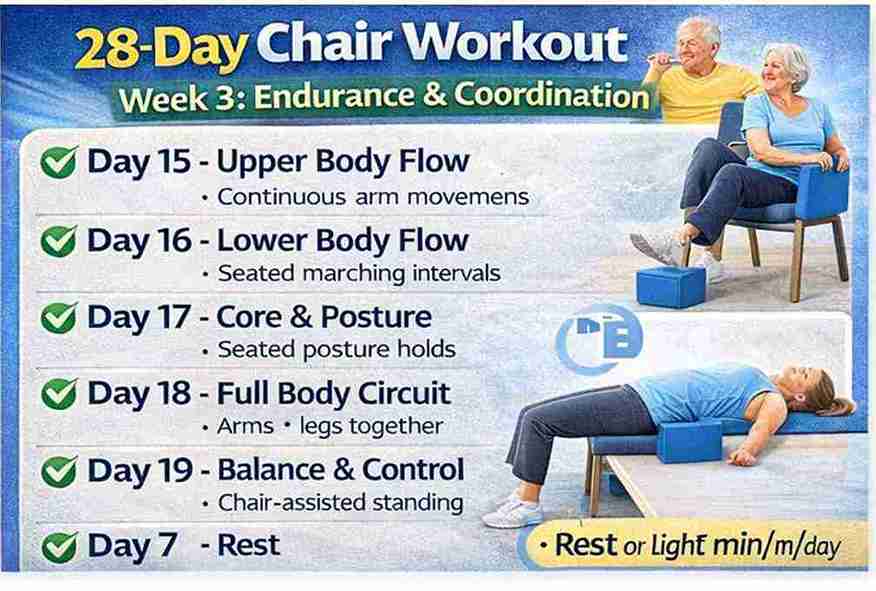
Week 3: Endurance & Coordination
Goal: Improve stamina and coordination
Time: 15–18 minutes/day

Day 15 – Upper Body Flow
- Continuous arm movements
Day 16 – Lower Body Flow
- Seated marching intervals
Day 17 – Core & Posture
- Seated posture holds
- Controlled twists
Day 18 – Full Body Circuit
- Arms + legs together
Day 19 – Balance & Control
- Chair-supported movements
Day 20 – Stretch & Breath
Day 21 – Rest
✔ What you should feel:
More energy and easier daily movement.
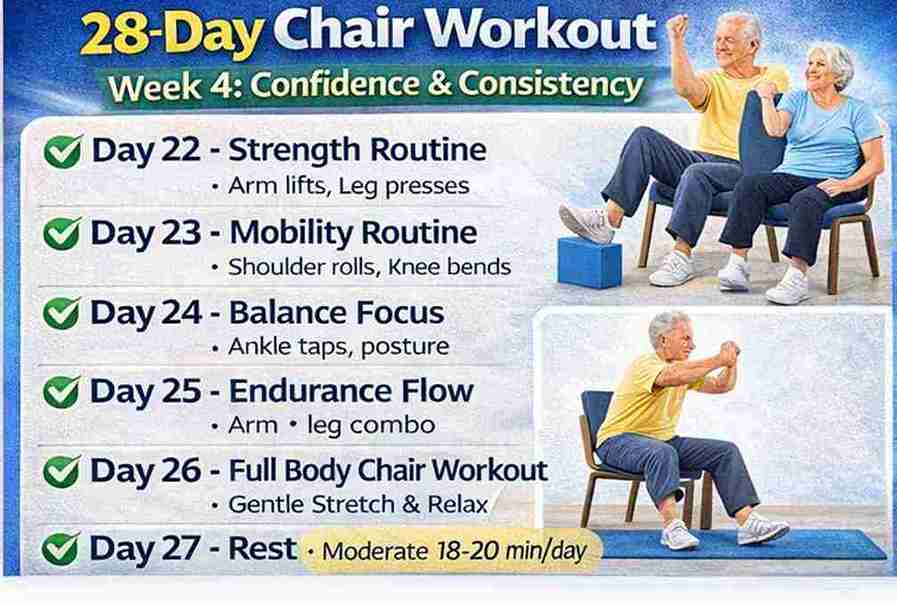
Week 4: Confidence & Consistency
Goal: Create a sustainable habit
Time: 18–20 minutes/day
Day 22 – Strength Routine
Day 23 – Mobility Routine
Day 24 – Balance Focus
Day 25 – Endurance Flow
Day 26 – Full Body Chair Workout
Day 27 – Gentle Stretch & Relax
Day 28 – Reflection & Light Movement
✔ What you should feel:
Improved confidence, balance, and independence.
Why a 28 Day Chair Workout Works Better Than Random Exercise
Most people fail with exercise because they:
- Don’t know what to do each day
- Try to do too much too fast
- Feel pain or discomfort
- Lose motivation
A 28 day chair workout plan solves this by:
- Creating a daily habit
- Progressing slowly and safely
- Reducing injury risk
- Building confidence over time
💡 Research shows structured programs improve consistency and long-term results far more than unplanned workouts.
- 📌 “Research shows that chair-based exercise can improve strength and overall physical function in older adults, such as better grip strength and sit-to-stand ability.” PMC
- 📌 “In intervention studies, chair yoga reduced pain, enhanced flexibility, and improved daily activity scores in seniors with osteoarthritis.” PMC
- 📌 “Expert consensus defines chair-based exercise as a seated program that promotes stability and progression for older adults with compromised mobility.” PMC
- 📌 “Chair workouts have been shown to maintain or improve mobility, balance, and independence in older adults, even in frail populations.” laterlifetraining
- 📌 “Health authorities note that chair exercises help build strength, flexibility, and stamina with lower joint strain.” Harvard Health
- 📌 “Studies suggest that chair exercises can significantly improve strength, flexibility, and reduce fall risk among seniors.” oliveeldercare.com

Why Some Seniors Feel More Tired in Week 2 Than Week 1
This catches people off guard.
Week 1 feels exciting.
Everything feels new.
People usually say:
“I actually feel better already.”
Then week 2 arrives.
Suddenly:
- energy drops
- legs feel heavier
- motivation disappears
- routines feel harder
People panic.
Usually nothing is wrong.
Your body finally realized:
this isn’t a one-time activity anymore.
Now adaptation starts.
Early motivation hides fatigue
Week 1 runs on excitement.
People:
- try harder
- ignore tiredness
- focus on progress
Week 2 feels different.
Now the body starts asking:
“Okay… are we doing this regularly?”
That’s usually when recovery starts becoming important.
Your body starts adapting, not resisting
A lot of people think:
“Feeling tired means exercise failed.”
Usually the opposite.
Your muscles.
Your circulation.
Your nervous system.
They’re adjusting.
That adjustment costs energy.
Especially after 60.
Sleep becomes more important than workout length
This gets ignored constantly.
People try:
- longer sessions
- extra repetitions
Usually sleep would help more.
Poor sleep affects:
- recovery
- soreness
- movement confidence
- motivation
Sometimes the best workout improvement is simply sleeping better.
Soreness and fatigue are not the same thing
Soreness:
muscles feel worked.
Fatigue:
the whole body feels slower.
That difference matters.
Older adults recover differently.
Adjusting doesn’t mean quitting
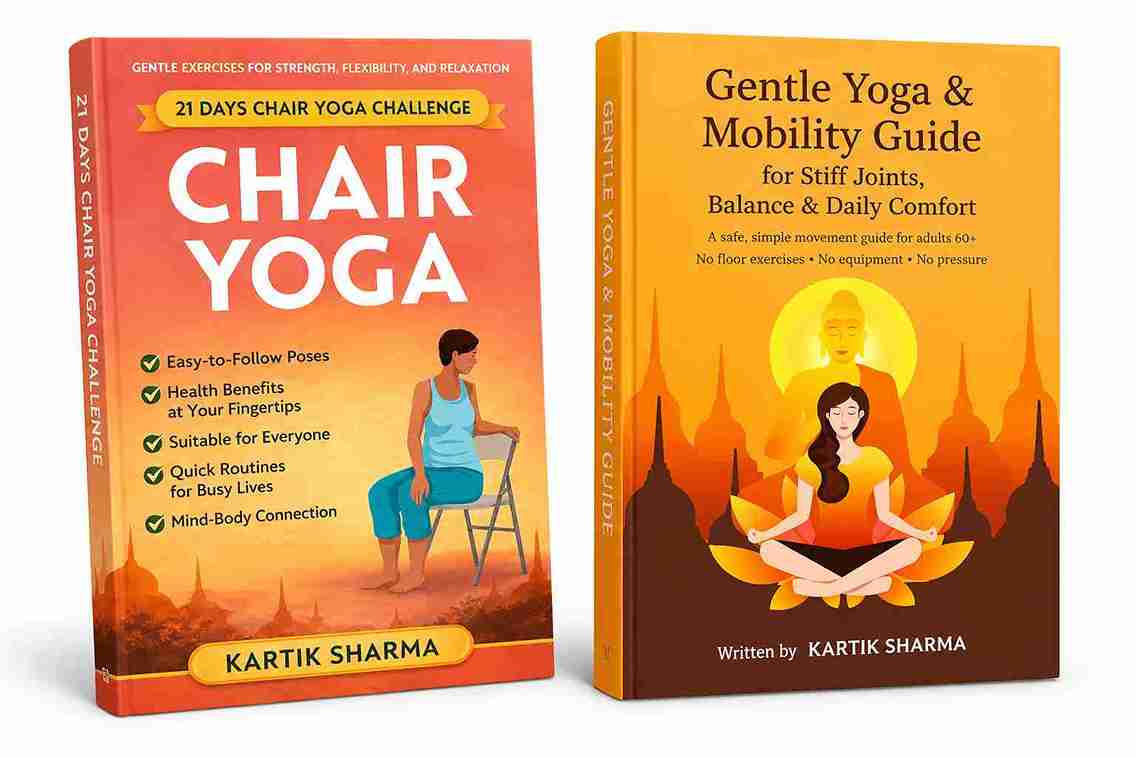
Gentle Chair Yoga Guides for Adults 50+
Two beginner-friendly guides designed to help support flexibility, balance, mobility, and everyday comfort with simple chair-based routines.
Week 2 is often where smart adjustments happen.
Examples:
- reduce repetitions
- shorten workouts
- move slower
Consistency beats perfection.
The Hidden Reason Random Rest Days Sometimes Work Better Than Perfect Consistency
People love streaks.
Real bodies don’t.
Especially aging bodies.
Recovery changes with age
Recovery becomes less predictable.
One day:
energy feels great.
Next day:
everything feels heavier.
That fluctuation is normal.
Rest improves movement quality
People assume rest means losing progress.
Usually recovery improves:
- posture
- coordination
- energy
Rest can make the next session better.
Low-energy days still count
Movement doesn’t always mean workouts.
Sometimes success means:
- walking more
- stretching lightly
- doing half the routine
That still supports progress.
One skipped day changes almost nothing
This helps people relax.
Missing one day rarely matters.
Quitting completely matters.
Big difference.
Recovery signs are worth tracking
Good recovery usually feels like:
✔ easier standing
✔ normal breathing
✔ less stiffness
✔ stable energy
Those signs matter more than streak counters.
Why Daily Energy Matters More Than Motivation During a 28-Day Program
People think motivation drives success.
Honestly…
Energy predicts consistency better.
Energy changes throughout the day
Morning might feel terrible.
Afternoon feels easier.
That doesn’t mean laziness.
It means timing matters.
Meals change workout tolerance
Too hungry:
low energy.
Too full:
sluggish movement.
Many seniors do best:
30–90 minutes after eating.
Sleep changes perceived effort
Poor sleep makes easy movement feel difficult.
People blame exercise.
Actually:
the body recovered poorly.
Build routines around good energy windows
Ask:
When do I naturally feel better?
That time often becomes the best workout slot.
Stop chasing perfect streaks
Perfect streaks fail.
Sustainable routines survive.
That difference matters.
Myth vs Reality: What Actually Improves First During a 28-Day Chair Workout
People expect dramatic changes.
Usually something smaller changes first.
| Myth | Reality |
|---|---|
| Strength improves immediately | Confidence often improves first |
| Daily workouts feel easier daily | Recovery fluctuates |
| More time means better results | Consistency matters more |
| Progress looks obvious | Daily life changes first |
| Hard exercise works faster | Joint tolerance matters |
Most progress appears outside workouts
People notice:
- easier standing
- smoother walking
- less hesitation
- getting dressed easier
That counts.
Confidence usually appears before strength
Movement becomes less scary.
That changes daily life quietly.
Energy improves gradually
Most people don’t suddenly feel transformed.
Small improvements stack.
Advanced Layer — What To Do After Day 28 So Progress Doesn’t Disappear
Most programs stop here.
Real progress starts now.
Keep 3 anchor workouts
Choose:
Workout A → mobility
Workout B → strength
Workout C → balance
Rotate them.
Simple works.
Progress slowly
Don’t double workout time.
Instead try:
- one extra repetition
- slower movement
- slightly better posture
Small upgrades last longer.
Track function, not workout minutes
Ask:
Can I:
- stand easier?
- climb stairs smoother?
- recover faster?
That matters more.
Build a maintenance month
After Day 28:
Week 1 → 4 workouts
Week 2 → 3 workouts
Week 3 → add variety
Week 4 → review progress
Eventually movement becomes normal life
That’s usually the goal.
Not perfect workouts.
Not streaks.
Just moving comfortably for longer.
Is a 28-Day Chair Workout Safe for Seniors?
Yes, when designed correctly.
A chair workout:
- Keeps you supported at all times
- Reduces fall risk
- Protects knees, hips, and back
- Allows gentle progression
This plan is suitable for:
- Seniors 60–80
- Beginners
- People with arthritis
- Balance concerns
- Limited mobility
⚠️ Always move slowly and stop if you feel pain or dizziness.
What You Need for This 28 Day Chair Workout
You only need:
- A sturdy chair (no wheels)
- Comfortable clothing
- 15–20 minutes per day
- A quiet space
- No weights.
- No gym.
- No floor exercises.
Free Printable 28 Day Chair Workout PDF
To make this plan easy to follow, many seniors prefer printed workouts.
Our free printable 28 day chair workout PDF includes:
- Large, easy-to-read text
- Daily checklist
- Simple illustrations
- Weekly progress tracker
PRINTABLE
Free Printable: Chair Yoga for Seniors (Step-by-Step Poses)
Get a beautiful A4 printable of 10 gentle chair yoga poses for seniors. Each pose includes clear instructions and breathing tips — perfect for daily use!
📌 Print it once and keep it near your chair no phone or internet needed.
How Long Should Each Chair Workout Be?
- Beginners: 10–12 minutes
- Progressing seniors: 15–20 minutes
Short, consistent workouts are far more effective than long, exhausting sessions.
28 Day Chair Workout vs Walking or Gym Workouts
| Feature | Chair Workout | Walking | Gym |
|---|---|---|---|
| Fall Risk | Very low | Moderate | Higher |
| Joint Friendly | ✅ Yes | ❌ Sometimes | ❌ |
| Equipment | None | Shoes | Machines |
| Home-Based | ✅ Yes | ❌ | ❌ |
| Consistency | High | Medium | Low |
Common Mistakes to Avoid
- Skipping rest days
- Moving too fast
- Holding breath
- Ignoring pain
- Using unstable chairs
Comfort always comes first.
FAQs
Is a 28 day chair workout effective?
Yes. A 28 day chair workout improves strength, mobility, and balance when done consistently and safely.
Can seniors over 70 do a 28 day chair workout?
Absolutely. Chair workouts are one of the safest exercise options for seniors over 70.
How many minutes should a chair workout be?
10–20 minutes per day is ideal for seniors.
Do I need equipment for a chair workout?
No. Just a sturdy chair and comfortable clothing.
Final Thoughts
A 28 day chair workout proves that exercise doesn’t have to be hard to be effective.
With consistency, patience, and safe movement, you can:
- Improve strength
- Reduce stiffness
- Increase balance
- Regain confidence
👉 Download the free printable 28 day chair workout PDF and start moving safely today.